Art driven image makeovers are being created around the metro this merry month of May. Consider Clive, surely the largest city in Iowa without a high school. Most towns identify predominantly with their schools, particularly with their high schools. Residents wear their colors, call themselves after their mascots, cheer their teams, and stay connected for decades through their reunions. How does Clive manage to build an identity without a school system?
The town has developed a park system that is the first thing many outsiders learn about Clive. Its Greenbelt Park & Trail System particularly projects a positive image. Each year, Clive’s park board, art council, city council, and chamber of commerce collaborate to commission sculptures of temporary public art for prominent placement along that 11.3 mile trail. Each May new works are installed for display through October. Art fans are then encouraged to vote for their favorite piece
(https://www.cityofclive.com/residents/public-art-program/vote/art-along-the-trail.php). The Clive Public Art Advisory Commission then chooses one of the top two vote getters for purchase for the city’s permanent public art collection. James Bearden’s “Paths Unite” was selected last year.
Last week I wistfully watched the installation of the late Mac Hornecker’s steel and ferroconcrete “Prairie Breeze” in Campbell Park, the site of the dedication ceremony for this year’s project (at 5 p.m. May 21.) A generation of students who were influenced by the charismatic Buena Vista University professor should be touched to view it. Other 2013 artists, their pieces and locations along the Clive Greenbelt Trail are: John Brommel – “Mist of Time” – University Boulevard & 78th Street Trailhead; Anna Modeland – “Devine Intertwine” – 100th Street & Maddox Parkway Trail Access; Sue Berkey – “The Red Coyote” – NW 114th Street Bridge over Walnut Creek; James Bearden – “Tranquility” – Lakeshore Drive & Woodlands Parkway Trail Access; and Hilde DeBruyne – “Hope” – Wildwood Park.
In East Village, Metro Waste Authority cleaned up their image by commissioning a three story mural by Chris Vance, a Bondurant artist who has created a personal iconography that is adored and collected by many. For this project Vance incorporated typical metro waste - plastic bottles, newspapers, refrigerators, etc. into his narrative. Many locals already love the mural, and some don’t, as usual. Not to blow wind on a dumpsite but let us hope this is legal. Just a few years ago the city demanded that a similar mural, commissioned by Rosa Martinez on a wall at La Rosa restaurant, be painted over. Despite hundreds of letters of support, and no complaint, it was declared illegal in Des Moines because its dancing foods “referred to the product of the business.” Don’t plastic bottles and refrigerators also refer to the product of Metro Waste’s business? Or has the city lightened up?
Polk County’s Heritage Art Gallery needs a new image. Mainly it needs its own image. When I searched for it on Google last week, the main result directed me to a web site (http://www.heritagegallery.org/) that displayed links to “free adult web cam sex,” “the You Tube of porn,” “American heritage girls” and several similar things. The real Polk County Heritage Art Gallery (http://www.polkcountyheritagegallery.org/) is trying to become younger and edgier but a visit to its current show is unlikely to offend anyone.
"III" A Medley of Sculpture, Light, and Canvas” is the first of multiple shows at the gallery for which Thee Eye’s Ian Miller will act as curator. It features oil paintings of blogger, and Juice columnist, Cat Rocketship, a reconstruction of a burned piano by photographer Dan Welk, and an installation of symbolic stop signs by screen printer Jon Pearson. On opening night, Pearson laid under one stop sign while Welk simulated burning piano aromas. Only Pearson’s feet were nude.
Love's Labour
After a longer than usual winter, Shakespeare‘s “new fangled mirth” of spring will be appropriately celebrated around central Iowa’s art scene. For the first time, Des Moines Art Center’s (DMAC) Iowa Artists’ Exhibition will include theatrics - three productions, in three different DMAC venues, of the Bard of Avon’s “Love’s Labours Lost” (April 26-28) by The Foss Projects. Last year this same troupe’s “A Hamlet Behind the Burger King in Ames” turned Shakespeare’s tale of woe amongst Denmark’s most dysfunctional family into an evening of humor and delight. Imagining what this creative Iowa State University based group does with genuine farce makes me giddy as one of the characters from the comedy. Also in the Iowa Artists’ show, Kathranne Knight’s bright works on paper explore the horizon line as both a pictorial device and a psychological space (through July 28 with an artist‘s talk on April 19).
The DMAC is also now displaying their prized new acquisition, Ai Weiwei's "Sunflower Seeds," in the lower level of the Meire wing. That pile of hand painted porcelain beads derives from a legendary 2010 exhibition of 100 million such seeds at the Tate Modern Turbine Hall in London. That show was considered a seminal statement on mass consumption and famine. Ai is sometimes considered "the new Andy Warhol" because of his mastery of many different, pop media. An outspoken critic of the Chinese government, he was runner-up for Time magazine's Person of the Year award in 2011. His latest headline maker is a cover of "Gangnam Style," an international phenomenon by South Korean rapper PSY. Ai’s four-minute long parody on YouTube criticizes the Chinese government's attempt to silence his activism.
In the spirit of the season, Olson- Larsen Galleries' new show (through June 1) features Tilly Woodward who presents super realist paintings of eggs and nests. In the same show Sarah Grant brings works titled “The Promise of Spring” and “Ice Going Out” while Scott Ross exhibits his trademark geometric abstractions. Chris Vance, Iowa’s most collected young artist and likely its most mirthful too, opened his seventh annual spring exhibition at Moberg Gallery (through May 18). Expanding on his usual cast of street characters and children‘s fantasies, Vance built murals out of individual pieces and also offered several that stood alone. He commences soon on a giant singular mural in East Village, a three story building that should bring some mirth to all seasons there.
The Anderson Gallery at Drake University is hosting an exhibition, “Proximity,” that features four graduating seniors in the springtime of their careers - Meanz Chan, Aron Johnston, Cecily Pincsak, and Hannah Pink (through April 28). Recently at the Anderson, Lauren Oliver won the Provost Purchase Award for “Prurock” her intaglio deconstruction of an old Singer sewing machine, Padraic O’Connell’s housepaint canvas of garbage in a coral reef won the Juror’s Choice Award for painting, while Katlynn Sammons won for sculpture with a construction assimilating furniture with Styrofoam, paper and video projection.
Touts
Grinnell’s Faulconer Gallery is exhibiting "Animals Among Us" which studies the intermingled destinies of humans and other animals… Steven Vail Fine Arts began appraisal and consignment services for prints and works on paper (309-2763)... The Ankeny Art Center will offer week long summer art camps for students K- 4th grade and 5 -8th grade. $50, all materials included (965-0940)… Iowa artists are invited to submit to the second annual “Celebration of Iowa: Agricultural Art Award” sponsored by the Iowa Department of Agriculture and Land Stewardship, the Iowa Department of Cultural Affairs and Iowa Farm Bureau. The theme this year is “Cultivating Change.” Youth first prize is $1,000, for adults it’s $1,500 (281-3858)… Des Moines Metro Opera will hold a ball to celebrates the 20th anniversary of their endowment vision, in The Temple for the Performing Arts on May 3. Tickets are priced from $150.
Thursday, July 18, 2013


Thursday, May 23, 2013
Seeing through “Transparencies”

In science, the word transparency refers to the physical property that allows light to pass through matter. Its political and social definitions have become far more muddied and ambiguous. The Des Moines Art Center’s (DMAC) dazzling new exhibition “Transparencies – Contemporary Art & the History of Glass” reflects upon both definitions while consistently suggesting there is more going on than meets the eye.
Ten artists from the US, Iran, Great Britain, Japan and the Czech Republic bring installations to the museum that frivolously flirt with the eye and then surprise us with their depth and complexity. Laura Fritz, a Drake graduate, hides her crystalline constructions in giant jewelry cases. To see their interaction with light, visitors must bend over like voyeurs peaking through keyholes. Ran Hwang builds chandeliers out of thousands pf crystal pin heads. Then she animates them with spiders and waterfalls erupting through videography and mirrors. Judith Schaechter creates brilliant Tiffany style stained glass windows and populates them with freakish characters.
Fred Wilson uses glass more politically. His installations “Beginning of the End” and “Drips and Drops” both reference negative racial implications of ink, oil and particularly tar. Suspended on the wall, they appear proud and lovely. Not so much when splattered on the floor. Wilson‘s “Iago’s Mirror” recalls a line that Shakespeare gave to his namesake villain regarding his obsession with his black hero Othello: “Were I the Moor, I would not be Iago: In following him, I follow but myself.” Subject and medium converge as Wilson constructs a black mirror by layering four levels of dark red glass in a Baroque style befitting the Venice of Othello’s day.
Two bottle artists demonstrate the political qualities of transparency. Matt Eskuche shares three pieces from his larger series “Trash Glass.” These bottles, plus an occasional can, goblet and candlestick, are flame worked and powder coated to look like glazed pottery, or porcelain. Yet they are stressed and damaged to resemble the leftovers from a red neck weekend of drinking and giving a damn about the consequences of littering.
Exhibition curator Laura Burkhalter compared his work to the still life Dutch Vanitas paintings of the 17th century. “The old masters depicted decadent tabletop arrangements of food and drink in excess, meant to suggest the ephemeral nature of worldly pleasure…Often included were glass and crystal objects to show off the artist’s skill at portraying transparency and reflection.”
Jim Dingilian catches smoke in a bottle. Then he paints its insides by sculpting away at walls of soot. The bottles themselves are discarded consumer items and his subjects are as mundane as suburbia. It’s Dingilian’s perspective that provokes reflection. Like the works of the Australian artist Patricia Picinini, featured at a previous DMAC exhibition, we glimpse from just beyond the edges of the outback at backyard swimming pools, garages, parked recreational vehicles, and couches left for trash. That point of view suggests what poet Archibald Macleish called “the little green leaves in the wood,” and its redemptive grace. Sadly, these remnants of the primeval forest look endangered by the recklessness of suburban aesthetics. The paintings themselves seem threatened by their delicate media, and their dependence upon the bottles remaining sealed.
Rachel Lee Hovnanian’s mirrors also conjure the spirit of Vanitas. They employ motion sensor lights to seduce anyone who might somehow pass a mirror without gazing at his image. As we look upon our images, we see ourselves through dead Narcissus flowers and vials of Botox, a beauty product suggestively derived from poison. “Transparencies” plays through May22.
Touts
Lauren Oliver won the Provost Purchase Award for “Prurock” her intaglio deconstruction of an old Singer sewing machine at Drake’s Student Exhibition. Padraic O’Connell’s house paint canvas of garbage in a coral reef won the Juror’s Choice Award for painting. Katlynn Sammons won for sculpture with a construction assimilating furniture with Styrofoam, paper and video projection. That show plays through April 5 at Anderson Gallery on the Drake campus.
Monday, January 21, 2013
The Year of Exalted Memories
The Des Moines Art Center’s (DMAC) exhibition year began with three brilliant films by Argentine Miguel Angel Rios and concluded with three more by Bavarian Thomas Demand. Both artists went to painstaking ends to preserve incidents that most people might quickly dismiss from memory. Angel Rios wistfully revisited his native Calchaqui Valley to film the boleadores he wielded as a child, filmed a dangerous game played in the slums of Columbia, and recreated a peyote trip he took in Mexico. Demand spent three and half months, with a staff of 14 animators, recreating paper models of a cruise ship dining room rocking in high seas, filmed a model of a surveillance camera in a Brazilian airport, and simulated rain by shooting candy wrappers through layers of glass.
Some of the best exhibitions of the year similarly recreated images that artists found irrepressibly significant. Lee Ann Conlan‘s “Souvenirs” at Thee Eye was a painfully autobiographical diary of a lifetime of absorbed cruelties, mostly from bad romances.

At Moberg Gallery, Frank Hansen’s “Growing Up Hansen” depicted the artist’s “bad-assed drunk” father, extracting teeth in the family kitchen, using an ax on the clothes dryer and taking gunshots at airplanes. Every piece in Steven Vail Fine Arts’ s current show “Sourced” demonstrates how photographic images inspire original art. In one, Phillip Chen recalls the relationship between his father and John Dillinger through trappings of the family restaurant and a death mask of the gangster. DMAC’s “The Whole World Was Watching” brought a collection of historic civil rights ear photos to town.
These are a few of our favorite memories of 2012:
Artist of the Year - Larassa Kabel held her second exhibition at Houston's Peel Gallery this year finding that her large paintings of floating horses now sell out as quickly as she is willing to paint them. She also exhibited at Miami's 101 Gallery and at Art Hamptons International Art Fair in New York's summer retreat. To complete a very good year, a painting of Kabel’s was chosen to grace the White House’s Christmas cards, landing the artist an invitation to a White House Christmas party. For that occasion she wore a vintage broach and earrings by Nicole Miller’s - a Moberg Gallery artist like Kabel.
Exhibition of the Year (museum) - Tony Feher brought imagination and a generous spirrit to his self titled show at Des Moines Art Center.
Exhibitions of the Year (gallery) - 1.) Moberg Gallery’s Ten Year Anniversary Show showed what a novice gallery can accomplish in just ten years. Represented were 12 local and 13 regional artists. Most showed up at the opening, many from long distances; 2.) Steven Vail Fine Arts collaborated with Osborne Samuel of London to bring “Exposition Henry Moore” to Des Moines - an American debut of the artist’s drawings for two of his iconic statues.

Exhibition of the Year (non-traditional venue) - Robert Spellman’s one night show was held in a parking garage under an East Village pub. His dazzlingly colored impressionist paintings rocked the dark bowels of that venue
Design of the Year - RDG Planning & Design’s work on the World Food Prize Hall of Laureates modernized the building without detracting at all from historic preservation.

Rising Star - Rachel Buse’s “Inverted Mountain” showed original talent for both irony and nostalgia. The Art Beacon, which she founded, became an exceptional outlet for art criticism.
Event of the Year - Jackson Pollock’s masterpiece “Mural” made a surprise visit to Des Moines, inspiring a host of Pollock themed events.
May Bands of Angels Sing You to Your Rest - A retrospective of paintings by the late Byron Burford played at Olson-Larsen Galleries… University of Iowa art school icons Mauricio Lasansky and Elizabeth Catlett died in April, just days apart from each other, and each just weeks one side or the other from their 97th birthdays.
Cameras & Conceptualism
Conceptual artist Thomas Demand built his considerable reputation photographing paper models of mostly famous places - the New York City hotel room where l. Ron Hubbard created Scientology, the studio of Jackson Pollock, the podium from which Slobodan Milošević gave his most infamous speech, the hole where Saddam Hussein was captured, and the Fukushima Daiichi control room where Japanese scientists faced certain death to save others from nuclear meltdown.
The Des Moines Art Center is currently exhibiting “Animations,” Demand’s first ever video-only show. The centerpiece is the 100 second long video “Pacific Sun” shot from a model Demand built (with 12 Disney animators over 3 and a half months) to resembles a dining room on a New Zealand cruise ship being rocked by heavy seas. Because the event being recreated caused little injury and no deaths, why would Demand spend so much time and effort on this relatively trivial subject?
“I am obsessive but I loved the choreography of the event. At first, I thought it was slapstick, one object is made to suggest Buster Keaton. Then by trying to analyze the movement, I realized that it had commonality with science. We were doing the same thing that those who study tsunamis, earthquakes and wave/particle duality do,” he answered.
Because the video appealed to the scientist Demand, he realized mid-project that he needed to film 240 frames per second, not the standard 120 of most animation.
“It looked too much like slapstick at 120. I didn’t want that. I wanted a beautiful dance,” he explained.
The sound of furniture sliding back and forth across the ship was created by rolling petrified oranges in a crate. Similarly the sound track in “Rain’ was made by recording eggs frying in considerable grease. That video shows candy wrappers being shot through layers of glass. A third video, “Camera,” shot a paper model surveillance camera resembling one Demand saw in a Brazilian airport. Its sound track took Portuguese announcements and muddled them into a Babel that Demand calls “the voice of Big Brother.”
At Steven Vail Fine Arts, prints by local artists Jeremiah Elbel and Phillip Chen join those of 13 internationally famous artists in the exhibition “Sourced.”
“Jeremiah and Phillip not only hold their own in this company, in many ways they are technically more ambitious,” said curator Breianna Cochran.
Much like Demand’s work, all “Sourced” prints either incorporate photography or were inspired by it. Elbel’s dramatic charcoal rubbing was modeled after a photo of self-immolation, perhaps the one that inspired Arab Spring. (Elbel won’t say.) Chen’s two etchings link his father and the gangster John Dillinger, who employed him. Blueprints of a Colt .45, Chinese restaurant trappings and an abacus are superimposed over a photo of the elder Chen’s apron and jacket. In the other half the work, Chen created a death mask portrait of Dillinger using software that plastic surgeons employ.
Also in the show: Mel Ramos’ take on a Velasquez nude, with the subject looking into a mirror reflecting a photo that looks like Christy Brinkley; Carmen Calvo blindfolding a 19th century Spanish solider with a beheaded Barbie doll; Nicky Hoberman’s disturbing study of pubescence; Brian Alfred’s dramatic rendering of a woman in front of his work in an Israeli museum, inexplicably blindfolded; Silvie Fleury’s marvelously accessorized corpse, arm sticking out of car trunk; Vik Munoz’s self portrait made entirely out of paper punches; John Baldessari’s depiction of a human arm fighting with a python; Donald Sultan’s choreography of cigar smoke rings; Eric Fischl’s rhythmic nude dancers; Graciela Sacco’s slingshots and Yankee caps in an Argentine protest; Jane Dickson’s homage to American neon; Julian Schnabel’s musing on old postcards, and Joe Andoe’s celebration of horses.
Some of the best exhibitions of the year similarly recreated images that artists found irrepressibly significant. Lee Ann Conlan‘s “Souvenirs” at Thee Eye was a painfully autobiographical diary of a lifetime of absorbed cruelties, mostly from bad romances.

At Moberg Gallery, Frank Hansen’s “Growing Up Hansen” depicted the artist’s “bad-assed drunk” father, extracting teeth in the family kitchen, using an ax on the clothes dryer and taking gunshots at airplanes. Every piece in Steven Vail Fine Arts’ s current show “Sourced” demonstrates how photographic images inspire original art. In one, Phillip Chen recalls the relationship between his father and John Dillinger through trappings of the family restaurant and a death mask of the gangster. DMAC’s “The Whole World Was Watching” brought a collection of historic civil rights ear photos to town.
These are a few of our favorite memories of 2012:
Artist of the Year - Larassa Kabel held her second exhibition at Houston's Peel Gallery this year finding that her large paintings of floating horses now sell out as quickly as she is willing to paint them. She also exhibited at Miami's 101 Gallery and at Art Hamptons International Art Fair in New York's summer retreat. To complete a very good year, a painting of Kabel’s was chosen to grace the White House’s Christmas cards, landing the artist an invitation to a White House Christmas party. For that occasion she wore a vintage broach and earrings by Nicole Miller’s - a Moberg Gallery artist like Kabel.
Exhibition of the Year (museum) - Tony Feher brought imagination and a generous spirrit to his self titled show at Des Moines Art Center.
Exhibitions of the Year (gallery) - 1.) Moberg Gallery’s Ten Year Anniversary Show showed what a novice gallery can accomplish in just ten years. Represented were 12 local and 13 regional artists. Most showed up at the opening, many from long distances; 2.) Steven Vail Fine Arts collaborated with Osborne Samuel of London to bring “Exposition Henry Moore” to Des Moines - an American debut of the artist’s drawings for two of his iconic statues.

Exhibition of the Year (non-traditional venue) - Robert Spellman’s one night show was held in a parking garage under an East Village pub. His dazzlingly colored impressionist paintings rocked the dark bowels of that venue
Design of the Year - RDG Planning & Design’s work on the World Food Prize Hall of Laureates modernized the building without detracting at all from historic preservation.

Rising Star - Rachel Buse’s “Inverted Mountain” showed original talent for both irony and nostalgia. The Art Beacon, which she founded, became an exceptional outlet for art criticism.
Event of the Year - Jackson Pollock’s masterpiece “Mural” made a surprise visit to Des Moines, inspiring a host of Pollock themed events.
May Bands of Angels Sing You to Your Rest - A retrospective of paintings by the late Byron Burford played at Olson-Larsen Galleries… University of Iowa art school icons Mauricio Lasansky and Elizabeth Catlett died in April, just days apart from each other, and each just weeks one side or the other from their 97th birthdays.
Cameras & Conceptualism
Conceptual artist Thomas Demand built his considerable reputation photographing paper models of mostly famous places - the New York City hotel room where l. Ron Hubbard created Scientology, the studio of Jackson Pollock, the podium from which Slobodan Milošević gave his most infamous speech, the hole where Saddam Hussein was captured, and the Fukushima Daiichi control room where Japanese scientists faced certain death to save others from nuclear meltdown.
The Des Moines Art Center is currently exhibiting “Animations,” Demand’s first ever video-only show. The centerpiece is the 100 second long video “Pacific Sun” shot from a model Demand built (with 12 Disney animators over 3 and a half months) to resembles a dining room on a New Zealand cruise ship being rocked by heavy seas. Because the event being recreated caused little injury and no deaths, why would Demand spend so much time and effort on this relatively trivial subject?
“I am obsessive but I loved the choreography of the event. At first, I thought it was slapstick, one object is made to suggest Buster Keaton. Then by trying to analyze the movement, I realized that it had commonality with science. We were doing the same thing that those who study tsunamis, earthquakes and wave/particle duality do,” he answered.
Because the video appealed to the scientist Demand, he realized mid-project that he needed to film 240 frames per second, not the standard 120 of most animation.
“It looked too much like slapstick at 120. I didn’t want that. I wanted a beautiful dance,” he explained.
The sound of furniture sliding back and forth across the ship was created by rolling petrified oranges in a crate. Similarly the sound track in “Rain’ was made by recording eggs frying in considerable grease. That video shows candy wrappers being shot through layers of glass. A third video, “Camera,” shot a paper model surveillance camera resembling one Demand saw in a Brazilian airport. Its sound track took Portuguese announcements and muddled them into a Babel that Demand calls “the voice of Big Brother.”
At Steven Vail Fine Arts, prints by local artists Jeremiah Elbel and Phillip Chen join those of 13 internationally famous artists in the exhibition “Sourced.”
“Jeremiah and Phillip not only hold their own in this company, in many ways they are technically more ambitious,” said curator Breianna Cochran.
Much like Demand’s work, all “Sourced” prints either incorporate photography or were inspired by it. Elbel’s dramatic charcoal rubbing was modeled after a photo of self-immolation, perhaps the one that inspired Arab Spring. (Elbel won’t say.) Chen’s two etchings link his father and the gangster John Dillinger, who employed him. Blueprints of a Colt .45, Chinese restaurant trappings and an abacus are superimposed over a photo of the elder Chen’s apron and jacket. In the other half the work, Chen created a death mask portrait of Dillinger using software that plastic surgeons employ.
Also in the show: Mel Ramos’ take on a Velasquez nude, with the subject looking into a mirror reflecting a photo that looks like Christy Brinkley; Carmen Calvo blindfolding a 19th century Spanish solider with a beheaded Barbie doll; Nicky Hoberman’s disturbing study of pubescence; Brian Alfred’s dramatic rendering of a woman in front of his work in an Israeli museum, inexplicably blindfolded; Silvie Fleury’s marvelously accessorized corpse, arm sticking out of car trunk; Vik Munoz’s self portrait made entirely out of paper punches; John Baldessari’s depiction of a human arm fighting with a python; Donald Sultan’s choreography of cigar smoke rings; Eric Fischl’s rhythmic nude dancers; Graciela Sacco’s slingshots and Yankee caps in an Argentine protest; Jane Dickson’s homage to American neon; Julian Schnabel’s musing on old postcards, and Joe Andoe’s celebration of horses.
Conceptual Art & a Generous Concept

“You were so good with words, and at keeping things vague,” from Joan Baez’s “Diamonds & Rust”
“Untitled (Structures),” Leslie Hewitt’s exhibition at the Des Moines Art Center (DMAC), had opening night visitors referring to Yazmina Reza‘s play “Art.“ In the latter, the lead character proudly reveals a large, expensive, completely white painting to his closest friend. Their relationship soon dissolves as differing opinions about what constitutes "art" lead to personal resentments of independent thought. In Hewitt’s exhibition, large, completely white pieces of slightly bent sheet metal are meant to resemble movie screens and to “explore the intersection of positive and negative space; illusion and form; history versus the lived experience.”
Her installation also includes a slide show of shots Hewitt took, in collaboration with Bradford Young, that reflect upon “the nuances of the Civil Rights era and the Great Migration and their relevance to younger generations.” Both parts of the exhibition were partially inspired by the Menil Collection of civil rights photographs, a number of which are poignantly assembled in the DMAC‘s separate but equal exhibition “The Whole World Was Watching.”
That latter show is filled with drama and irony. A Bruce Davidson photo shows a black woman being arrested in front of a movie theater marquee announcing “Damn the Defiant.” A white supremacist’s infant, dressed in Klan regalia, looks frightfully mutant in an Elliot Erwitt shot. Asked if any of the seven featured photographers were African-Americans, curator Michelle White pointed to a Danny Lyon photo of black photographer Clifford Vaughs seemingly being ripped apart by Maryland National Guard troops during a 1964 demonstration.
“No, it was a matter of access,” she answered.
Such drama and irony might haven given context to Hewitt’s vague conceptualism. Instead they are shown in a separate gallery, on a separate floor. Hewitt, who has a masters degree from Yale, did not grant media interviews in Des Moines. In a gallery talk, she and Young lavished praise on one another while explaining their work pedantically. Hewitt used forms of the word “paradigm” a dozen times. In the only audience question they took, Hewitt was asked if an image of the Florida A&M band, referenced multiple times in her talk, was intended as an ironic statement about civil rights today, since that the band had been disbanded after black members murdered another black member in hazing rituals. She said she had “no idea” what the question referred to and that the Florida image was intended “as symbol of the Great Migration.” No more questions were allowed. However, in a 2011 interview with Indie Wire, Young, the highly acclaimed cinematographer of “Pariah,” revealed: “I would say more but Leslie Hewitt always tells me ‘Don’t give away your DNA.’”
Odds are long against that happening before January 6 when this show moves on to Chicago and Los Angeles.
Two other steel sculptures landed in the metro with back stories that had nothing to suppress. Urbandale High School 3D Art teacher Chris Kimble encouraged his students last year to visit public art pieces in the area and to create dialog pieces in response. Models of those pieces were placed in competition. Kimble asked Quality Manufacturing of Urbandale to judge. The company liked the idea so much they promised they would manufacture and install the winner’s work, a gift worth some $10,000.
Quality Manufacturing President Tom Carder couldn’t choose between MacKenzie Knight’s 13 foot tall “The Dance of Life” and Cole Jeanblanc’s 3800 pound “Reaching Hand.”

So he decided that his company would make both sculptures. They can now be seen outside the UHS Performing Arts auditorium. An encore performance is in place this year with installations for other public spaces in Urbandale.
Touts
Susan Chrysler White’s brilliantly colored Op Art paintings show at Olson-Larsen through November 24... Moberg Gallery’s 20th Anniversary anthology show also runs through November 24... Amy Putney Koenig’s “Shapeshifter” reflects upon death and survival through October at Thee Eye.
Three Big Touts for Art Stop
Art Stop, Des Moines’ autumnal celebration of the arts, has been expanded this year to three full weekends. Three very different artists’ new shows demonstrate a range of creativity worth celebrating. Since he opened a gallery ten years ago, with Jackie Moberg, TJ Moberg has been too busy to prepare a show of his own art. Plus his work has been too much in demand. Besides numerous commissions, anything else he made sold immediately. So in order to have a show, he had to hold a year of work off the market. The result is called “Skins” and runs through October 6 at Moberg Gallery.

“Skins” is also Moberg’s name for the dried paint assemblages that are the foundation of the works in this exhibit. After drying in the bottom of paint cans, they are torn, chipped and mixed with found objects before being assembled and then bathed in a solution of epoxy and chemical conditioner, blowtorched and cooled. The result is so smooth looking it belies ragged, even dangerous, textures.
Some of these works are quite personal. “Trans Am” is an homage to his native Eastside. “The firebird says mullets, fast living and cut off tank tops. It’s a giant bird logo on the hood of a 6.6 litter V8. Can it get any more over the top than that?” he asked.
Artist Chris Vance suggested that the process TJ has invented has parallels with Jackson Pollack invention of “action painting” seven decades ago. TJ is amused by that. “Ha. Jackson Pollack and TJ Moberg mentioned in the same sentence - and it’s not about drinking? I’m just excited to be creating works of art that are like nothing else I have created. I want to keep pushing my own comfort levels and not get complacent with successful work.”

Saley Nong’s “Not for Sale” at Thee Eye Gallery is a collection of installations that are as perishable as the foods from which most of them are constructed. Their playful, carefree nature does not detract from their existential portent. “Waiting” is made of Sweet & Low packets with chicken wire but looks like a body seeking a sarcophagus. “Mended Heart” is made with a freshly harvested cow’s heart, jute, caramelized sugar and honey. “Desire” amounts to lard, sugar, barn wood and chicken wire all crucified with long nails. “Table for Turds” presents a lavishly set dinner table with roses, candelabra, linen and exquisite china under entrees of cow shit. “Blood Butter” bonded by mixing its (pig’s) blood with cream fat, before cooling and sculpting. “Cotton Candy Hair” is made with human hair wigs, all remarkably similar. “My Mother” was built with patties of steamed sticky rice. A digital print of the artist’s faces advised “See Evil, Hear Evil, Speak Evit.“

Dan Mason’s new paintings, at Olson-Larsen Galleries through October 6, dazzle with contradictions. He chooses durable, even indomitable, subjects like old Brooklyn neighborhoods, stones, harbors and the sea. Then he portrays them, minimally, as mystical and ephemeral. The paintings look like single applications of oil on coarsely woven linen. Yet each one actually has at least 14 ultra thin layers. Mason never uses green paint though the greens he creates, by mixing layers of other colors on the linen, are the most brilliant in this self-described colorist’s spectrum.
Art Stop continues each weekend through September.
“Fantasy Environments” at Thee Eye
Where can a person find affordable art in Des Moines that is also worth collecting? That’s probably the toughest question I’ve been asked on this beat. In popular lore arts festivals are such places. In reality, prices at much-hyped festivals have crept up faster than algae in a heat wave. I prefer the odds at young blooded galleries and in organizational shows.
Ian Miller’s Thee Eye Gallery has a knack for finding affordable quality. Currently it’s hosting a show by Rachel Buse, a Nebraskan who moved to Des Moines four years ago after meeting a musician on the internet. (They are still together.) She’s a farsighted sculptor, broadening her horizons at all compass points. She’s joined Des Moines Social Club, Art Noir and Des Moines Art Center’s (DMAC) docent program. She teaches for ASAP, an inner city arts workshop for elementary school kids. She founded Art Beacon, a comprehensive web site for local art criticism.

Buse builds large paper and fabric structures that exaggerate “fantasy environments.” Her subjects range from rotary phones to lovable freaks. The Thee Eye opening was a grand affair. The artist completed “Inverted Mountain,” a two story installation she’d been laboring on all week. The place was packed with enthusiasts and buyers. Buse’s sculptures are all priced $200 or $500 and have been selling quickly.
“Some think I undervalue my work but I believe $200 and $500 is an investment. It’s enough for me to make more art too. These are my babies and they take up a lot of space. I like knowing they’re going to loving homes. I view it as a partnership,” she explained.
“Inverted Mountain” plays through Aug. 25. In September, Buse will ride a mobile sculpture through Art Stop and Project Spaces’ three different weekends, and art districts. She’ll also parade sculptures through Evelyn Davis Park with ASAP, and work on DMAC’s “Living Pollock’s Life” project.
Iowa Watercolor Society’s 35th Annual Exhibition fills every gallery, hallway, nook and cranny at Ankeny Art Center. Watercolors even hang in the men’s and ladies’ room. I counted 65 paintings by 47 artists at prices ranging from $100 - $3000. Artists included revered masters such as Richard Leet, successful full time artists like Mary Beth Heikes, art fair veterans like Jan Vander Linden, and hobbyists. No beginners though, every artist has been accepted to at least three previous shows.
Some stood out. Jac Tilton showed pieces that stylized a superb photographer’s chronicles of crumbling rural landscapes. Linda Fries demonstrated an Asian aesthetic regarding nature and transience. Susan Baer showed that watercolor can be controlled to create intricate patterns, a task usually left to software these days. Marvella Blome expressed intricate detail. Leet, as always, dazzled with his minimalist expression. This plays through Sept. 27.
“Global Views: The Art of New Iowans” opens August 27 at Heritage Gallery and runs through October 4. Curator Mary Brubaker says the show is a 21st century equivalence of older traditions.
“Ever since Governor Robert Ray welcomed ‘the boat people’ fleeing war during the 1970's, immigrants and other foreign born people have brought their artistic talents to Iowa as our ancestors did with Norwegian rosemailing, Czech painted wooden eggs, Amish quilts and Mexican pottery.”
Language barriers created serious challenges. “They come from all walks of life. Amer al Obadai from Iraq was a well known professional. Peter Coyle was a school administrator in England. Others worked in menial and exhausting jobs. Some married into western families. Some were adopted. It was hard to convince some that their art is worthy of an exhibition,” Brubaker says, adding that the show demonstrates mutual benefits for the artists and Iowa.
“Art is an international language and Iowa has become more multilingual because of these families,” she says. A public reception will be held September 14.
New Artists, Shakespearean Artists & Emerging Artists
Moberg Gallery’s “New Artists Exhibit” (through August 18) introduces five artists from far parts of Iowa and the world.

Last year at Travis Rice’s opening, that artist recognized a gallery visitor and exclaimed “Holy shit, you’re Bart Vargas.” Vargas, who has an international reputation as a found object and up cycling artist, responded “Holy shit, someone here knows who I am.” Well traveled Vargas hangs his hat in Council Bluffs these days and debuts in Des Moines with an installation of 104 latex paintings on panels, all with the look of Pointillism on steroids.
From the other side of the state Gary Kelley brings a series of paintings depicting famous Iowans. Young Laura Ingalls Wilder reads to her Holstein cow, Bix Biederdeck relaxes with his horn, Norm Borlaug works in front of the family barn in Cresco, Black Hawk poses ominously for a portrait, Bill Cody works the range, the Ringling Brothers do their thing in the ring, and Carl van Vechten has drinks with Lost Generation super stars Gertrude Stein, Pablo Picasso, Alice B. Toklas and Ernest Hemingway.
David Rose grew up the nephew of his inspiration - Chuck Close. Rose taught meditation in Europe for many years and now brings to this show a digital series of deeply meditative fractal and vector images on aluminum and paper. Some can astound the eye.
Finally, old India hands Michael and Charlotte Cain share their Hindu inspired meditations on Vedic gods and Moghul miniaturists. Charlotte’s are in gouache on panel and Michael’s are bronze and wooden sculptures.
Makeovers for the Bard
Shakespearian doings are quite different this year. Repertory Theater of Iowa’s partnership with Salisbury House is kaput. There will be no Shakespeare on the Lawn this summer. After a couple years of experiments with re-interpreted, multimedia Shakespeare, the Iowa Shakesperience Fest is returning to literal Bard interpretations - with “Romeo & Juliette” at Simon Estes Pavillion July 18 - 22. There may never have been such a tale of woe, but happily these productions remain free.
After debuting earlier this month in Ames’ “the alley behind Burger King,” Matt Foss’s Iowa State University theater troupe is taking their shoestring budget, big imagination production of “A Hamlet” to Mississippi, coincidentally the site of William Faulkner‘s “The Hamlet.” What’s in an article? This brilliant show uses just six actors playing many parts. Ophelia is also Gertrude which explains a lot about the problems of the former. No liberties are taken with the script despite the fact that Laertes is played by a football and several characters by puppets. The troupe hopes to bring this show to Des Moines and Council Bluffs after Mississippi.
Raw Art
Mixology (July 21 at Wooly’s in the East Village) brings a “circus” of local emerging artists in hair, makeup, fashion, photography, visual art, performing art, and music to town. This event is the local kickoff of “Raw: Natural Born Artists,” an arts group out of Los Angeles that promotes similar monthly shows in 54 cities now with Des Moines on board. Their mission is simply to help artists in the first ten years of their careers “get their work out there.”
The lineup at Wooly’s will include: hair stylists Brianne Cummins, who is also celebrating her one year anniversary in her salon this month, and Amanda Marie; makeup artists Kourelea Nicole, Pamela Loyola and Lindsay Ritland; fashionista La Bella Figura (Elena Flores); jewelry maker Joy Hockensmith; exotic dancer Jen Kees; body artist Emily Svec (Body by Svec); photographers Tessa Leone and Cameron Hart; tattoo artist/painter Knappy; artists Brent Westpahal, Brianna Dawson, Michelle Holley, Ryan Siedel, Christina Tufty, Ryan Saggau and D. Ryan Allen; and the bands Hath No Fury and Longbottom Leaf.
If that’s not enough of a circus for you, Woz will be ringmaster and DJ Flash will do his thing too. Tickets are $10 advance or $15 at the door. Artists may submit their work for future shows at http://www.rawartists.org/register
Touts
Olson-Larsen Galleries opens their exhibition of New Works by two of Iowa’s most interesting stylists Mary Koenen Clausen and Kim Hutchison.
Life is an open painting
Outside of literature, autobiographical art is a hard sell. Louise Bourgeois managed to insert her life story in sculpture by using recognizable symbols (like spiders) of her inner demons thus making the art more universal and less opaque. It’s even tougher to tell your life story in flat media like painting and printmaking. Still two local artists defy the odds.
Lee Ann Conlan used to paint large $12,000 canvasses, with big, Boschian themes like evil and punishment. She did quite well, selling out shows in the first half of the last decade. Her latest exhibition at Thee Eye reveals a swing in her choices of media and subject matter.
“I went back to school to study graphic arts. The new technologies are so amazing. You can work in so many layers of images and words. I’ve always want to do a visual book so I made this series (of digital collage prints),” she explained of a slick $40, 70 page book of prints that mostly sell for $30 to $60 each.
“It’s another time now economically. People don’t need art like they need food and shelter. It’s one of the first things they cut out their budget. I want my art to be in more homes, so I became more accessible,” she said.
The dominant series (Souvenirs) in her new show is painfully autobiographical, like a diary of a lifetime of absorbed cruelties. “Actually, it was all just one guy, (depicted here as “Little Man“ and “Dirte“). Fear becomes anger and anger has to end with humor if you want to get through it all,” she explained.
Her titles explained a lot. “Nobody likes you. They only pretend to like you because you hang out with me.” “You’re fucking me and kissing my tears.” “I’d like to grab you by the hair and sell you to the devil.” “I was in shock that you could hate me in a matter of days. I already hated you.” One piece told how that abusive relationship ended, depicting an SUV, via Google Earth, in the parking lot of the Lumberyard (strip club) with an inserted photo of two infants left alone. Another (“The Randolph”) placed a woman on the floor of a crack house. “It was the day after St. Patrick’s Day and I woke up to discover that I was in Mexico and that I was married,” she recalled.
Another series in the show told about another bad relationship. For it she sewed 80 feet of “love letters,” scribbled on all kinds of paper, to her medical records (from a fractured skull). She called this “Red Flags,” to chastise herself for not sensing the danger implied in the strange letters. This show runs through June.
At Moberg Gallery Frank Hansen recently explained his penchant for autobiographical art. “I believe my life is more interesting than most. I am Frank. I am the definition of my name. If you don‘t like it, too bad.”
His current show “Growing Up Hansen” (through July 7) tells stories about his “bad-assed drunk” father: extracting teeth in the family kitchen; using an ax on the clothes dryer; dragging the family to yard sales “until we were surrounded by junk;” and taking gunshots at airplanes flying too close to the ground. There’s also a “hay ride wrapped in infamy,” “pre-sexual sex dreams,” the accidental (or not) burning of his grandma’s farm, and a pet duck frozen in the snow.
Side Galleries
Robert Spellman’s recent one night exhibition was held in a parking garage under an East Village pub. His dazzlingly colored impressionist paintings rocked the dark bowels of that venue… Pete Goche’s “Water Hutch” is on exhibit through August 5 at the Soap Factory in Minneapolis. It was one of just 7 pieces selected from more than 500 international applications to the experimental gallery.
Des Moines Arts a 25 year review
Twenty five years ago I became an arts writer, accidentally. I published a whimsical editorial (“I’ve seen the future of the arts - it looks like baseball”) in The Washington International Arts Letter (WIAL). That publication was the main guide for information about funding in the arts before the internet rendered it obsolete. My piece proposed that symphonies, operas, art museums, ballets and such would all benefit by adopting the structure of baseball’s farm system. Des Moines’ arts organization could become AAA affiliates of Chicago‘s, tutoring young prospects while increasing the marketing clout of both.
Arts non profits were becoming desperate back then. Attendance was down and so was earned income as a percentage of operating budgets. Their devoted fans and donors were aging and younger generations cared more about sports, rock bands and Broadway shows. In that climate, my idea was taken seriously. I was invited to speak at arts seminars and to become editor of the WIAL. My fifteen minutes lasted less than a year. The farm system analogy sounded good in theory but died hopelessly in the real world, where unions and insurers squashed it. I continued writing about the arts for a quarter century. These were the biggest agents of change that I noticed:
Big corporate donors reorganized the way money was distributed to non profits by putting marketing departments in charge of those decisions. They demanded quid pro quo, so non profits had to convince donors that they were getting some positive return. This led to silly things like naming rights for drinking fountains and toilets, but also to far more educational services. Those programs and events recruited a future fan base and earned income rose.
Robert Maplethorpe and Andres Serrano offended social conservatives with erotic and profane art that had indirectly received grant money from the National Endowment for the Arts (NEA). This led to the creation of new levels of bureaucracy, both public and private, to build walls between big donors and ultimate consequences of their largess. The Iowa Department of Cultural Affairs was our state version, BRAVO and Greater Des Moines Music Coalition (DMMC) regional ones, Metro Arts Alliance a civic one.
Sociologist Richard Florida published “Rise of the Creative Class” in 2002. He theorized that successful cities of the future must pander to a new class of workers who hate suburban sprawl and love bike trails, sports arenas, skate board ramps, historic old buildings, cheap rent, trendy cafés & boutiques, multiculturalism, and, above all, a lively contemporary music scene. Florida’s theories were discredited soon after they were published - his ten “most creative cities” barely created more jobs than his “ten least creative cities.” It didn’t matter, every town was afraid they‘d be left behind if they didn‘t build to Florida‘s models. Iowa hired him in 2005 to brand its Great Places program. Every seminar or focus group I attended the last decade was filled with drinkers of Florida Kool-Aid. Most artists and arts organization seeking grant money claimed to be an essential part of the Florida vision. Des Moines’ creative class - of administrators - grew again.
More interesting work was done by impresarios doing business the old fashioned way - making money by developing talent. A lively music scene arose here because club and bar owners took risks that live music, from near and far, would pay off. New gallery owners and art makers (Sticks) gave young artists a place to test the market for their talent. Some developed farm system-like alliances with galleries in Chicago, Kansas City and Los Angeles.
The role these people played has been underestimated, at least by the administrative class. Last month, a DMMO awards ceremony honored a marketing administrator, a board member, a band leader, a radio personality and a guitar maker but presented nothing to any promoter, club or bar owner. Those people made it possible for musicians to make a living here, rather than leaving town. I doubt any of them ever read Richard Florida.
Sunday, August 12, 2012
Reliquaries, Paraphilia & Coincidence
Des Moines Art Center’s “Tony Feher” retrospective stretches the museum in more ways than one. “Tony’s done 160 exhibitions since the early 1990’s, mostly in site-specific venues. I don’t think anyone has ever attempted a retrospective of that sort of thing. And of all the places this show is traveling, Des Moines is special because we were able to invade the permanent collections. So look for the show in the Pei and Meire wings as well as in its own gallery,” explained curator Claudia Schmuckli, from Houston’s Blaffer Gallery.
Feher likes his art defies some expectations. “I was a struggling painter until one day I saw some marbles in the window of a toy store, with the light hitting them in just the right way. I bought them and put them in jars,” he explained of his style’s origin. One thing led to another. Because AIDS was taking so many lives unexpectedly, he began putting things in jars that served as memorials. Soon his jars were being exhibited and described as modern reliquaries of collective memory. Jars led to plastic bottles which he hung in trees, high enough so that his art could not slam dunked by locals. “I was drawing with rows of bottles,” he explained. He’s now “drawn” on some famous museums, discovered all kinds of unorthodox art materials, and installed living art (apple trees) in the courtyard of the city of Rockford, Illinois. Tony Feher plays through September 2.
Des Moines poet Mia L. Farrell published “Perverse Moments,” an adult coloring book that graphically and hilariously defines forty or so fetishes and paraphilia, a.k.a. sexual perversions. Her inspiration was the Garbage Pail Kids of the 1980’s.
“I loved their irreverent combination of two of my favorite qualities: huggable, wholesome cuteness and blatant, uncensored hard core, vomit inducing grossness. It made for such a beautiful thing,” she explained. Farrell thought it was time to inject sex into a similar Hegelian dialectic.
“So with the extreme wealth of sexual knowledge available on the internet, I set out to draw page after page of the cutest, kinkiest cartoons.” She succeeded. Her first printing sold out quickly and at least one big time distributor is interested. She says it’s about education.
“If something makes us too uncomfortable to find humor in it then we’re choosing to remain too afraid to ever understand it.”
Former University of Iowa art school icons Mauricio Lasansky and Elizabeth Catlett died in April, just days apart from each other, and each just weeks one side or the other from their 97th birthdays.
Touts “Exposition Henry Moore,” currently at Steven Vail Fine Arts, includes lithographs, etchings and mixed media works relating to the artist’s iconic “Mother and Child” and “Reclining Figures” series. A collaboration with Osborne Samuel of London, it’s the first exhibition of its kind in the United States. The works span 1963-1983, demonstrating a range of Moore’s working styles. The exhibition plays through July 20. … Frank Hansen’s first local exhibition in two years debuts May 18 at Moberg Gallery. Hansen’s often autobiographical explorations of Iowa’s past and present always bring out one of the year’s wilder gallery gatherings… Chris Vance has been Des Moines’ most collected painter for awhile but his latest show at Moberg set new sales records. Paintings sold so briskly that the entire show had to be re-hung with new works before it was over… “All Fired Up - Works in Clay” at Polk County Heritage Gallery presents a veritable student all star show from RDG Dahlquist Art Studio, through June 7.
Feher likes his art defies some expectations. “I was a struggling painter until one day I saw some marbles in the window of a toy store, with the light hitting them in just the right way. I bought them and put them in jars,” he explained of his style’s origin. One thing led to another. Because AIDS was taking so many lives unexpectedly, he began putting things in jars that served as memorials. Soon his jars were being exhibited and described as modern reliquaries of collective memory. Jars led to plastic bottles which he hung in trees, high enough so that his art could not slam dunked by locals. “I was drawing with rows of bottles,” he explained. He’s now “drawn” on some famous museums, discovered all kinds of unorthodox art materials, and installed living art (apple trees) in the courtyard of the city of Rockford, Illinois. Tony Feher plays through September 2.
Des Moines poet Mia L. Farrell published “Perverse Moments,” an adult coloring book that graphically and hilariously defines forty or so fetishes and paraphilia, a.k.a. sexual perversions. Her inspiration was the Garbage Pail Kids of the 1980’s.
“I loved their irreverent combination of two of my favorite qualities: huggable, wholesome cuteness and blatant, uncensored hard core, vomit inducing grossness. It made for such a beautiful thing,” she explained. Farrell thought it was time to inject sex into a similar Hegelian dialectic.
“So with the extreme wealth of sexual knowledge available on the internet, I set out to draw page after page of the cutest, kinkiest cartoons.” She succeeded. Her first printing sold out quickly and at least one big time distributor is interested. She says it’s about education.
“If something makes us too uncomfortable to find humor in it then we’re choosing to remain too afraid to ever understand it.”
Former University of Iowa art school icons Mauricio Lasansky and Elizabeth Catlett died in April, just days apart from each other, and each just weeks one side or the other from their 97th birthdays.
Touts “Exposition Henry Moore,” currently at Steven Vail Fine Arts, includes lithographs, etchings and mixed media works relating to the artist’s iconic “Mother and Child” and “Reclining Figures” series. A collaboration with Osborne Samuel of London, it’s the first exhibition of its kind in the United States. The works span 1963-1983, demonstrating a range of Moore’s working styles. The exhibition plays through July 20. … Frank Hansen’s first local exhibition in two years debuts May 18 at Moberg Gallery. Hansen’s often autobiographical explorations of Iowa’s past and present always bring out one of the year’s wilder gallery gatherings… Chris Vance has been Des Moines’ most collected painter for awhile but his latest show at Moberg set new sales records. Paintings sold so briskly that the entire show had to be re-hung with new works before it was over… “All Fired Up - Works in Clay” at Polk County Heritage Gallery presents a veritable student all star show from RDG Dahlquist Art Studio, through June 7.
Thursday, June 14, 2012
Life Imitating Art Imitating Life
Sixty years ago art critic Harold Rosenberg wrote that Jackson Pollock had “transformed painting into an existential drama” in which "what was to go on the canvas was not a picture but an event.” Pollock’s seminal painting “Mural” arrived in Des Moines earlier this month as both big event and existential drama in this, the 100th anniversary of Pollock’s birth.
To celebrate Iowa’s prime spot in the art world, Des Moines Art Center (DMAC) invited members to a pre-launch party for the unveiling of “Mural,” which is on sabbatical from the University of Iowa floodplain. Over 500 people returned RSVP’s. Many more showed up as super star art patrons John and Mary Pappajohn hosted the bona fide gala. Three cops patrolled the parking lots. Cars were parked all the way to the old Science Center. Shrimp were super sized and booze was top shelf.
Pollock was an All American cultural meteor on a crash course with destiny in real life and myth. He was born in Cody, Wyoming, a town named after Buffalo Bill whose life and mythology resembled Pollock’s in many ways. Expelled from two high schools, Pollock tagged along on surveying missions with his father to Native American reservations. A long time alcoholic, he coped with his addiction through Jungian therapy but died at age 44. Before his final fatal fling with drunken driving, Pollock also stole Abstract Expressionism from the Germans, remodeled it in epic proportions, Americanized it by synthesizing Navajo sand paintings with Jungian motifs, and shifted the axis of the art world from Paris to New York City. Those are just the non controversial highlights of his legacy.
“Mural” is usually considered the work that jump started all that transformational art stuff. DMAC Director Jeff Fleming explained. “It changed the way Americans painted pictures and in turn changed the way that western visual culture operated after World War II. A part of that was in its scale. In contradiction to easel sized painting, it was on a grand scale, full of energy, vitality and emotion. It changed what painting could be, particularly what American painting could be. And this is the painting that started all that,” he said. University of Iowa President Sally Mason focused on encouraging DMAC patrons to oppose any legislative moves to sell the painting to raise money for scholarships, or new buildings.
“Mural” is estimated to be worth around $150 million. The proposal to sell it (publicly articulated by Michael Gartner who is both a former President of the Iowa Board of Regents and an owner of this newspaper’s parent company) has garnered enough support to worry many folks who attended the Pollock party.
Everyone speaking at the gala seemed rather passionate about keeping “Mural” in Iowa, for several reasons: The painting was given to the university in large part to recognize the incredible talent that made its art school famous, including Grant Wood and Philip Guston; The University pioneered the concept of making painters into teachers; Pollock’s parents grew up in Iowa; The painting is a Hawkeye heirloom.
Art Touts
A retrospective of paintings by Byron Burford plays at Olson-Larsen Galleries through May 26. Burford came to the University of Iowa to study with Grant Wood. He left only to serve in World War II, teaching several generations of grateful students. Jazz and the circus motifs show off his lyrical perspective of 20th century America… Chris Vance, Des Moines’ most collected painter, is featured at Moberg Gallery through May 11. His paintings have been selling so briskly that this entire show might be re-hung with new works before it’s over… Former University of Iowa art school icons Mauricio Lasansky and Elizabeth Catlett died in April, just days apart from each other, and each just weeks one side or the other from their 97th birthdays.
Thursday, May 10, 2012
Des Moines arts - a 25 years review
Twenty five years ago I became an arts writer, accidentally. I published a whimsical editorial (“I’ve seen the future of the arts - it looks like baseball”) in The Washington International Arts Letter (WIAL). That publication was the main guide for information about funding in the arts before the internet rendered it obsolete. My piece proposed that symphonies, operas, art museums, ballets and such would all benefit by adopting the structure of baseball’s farm system. Des Moines’ arts organization could become AAA affiliates of Chicago‘s, tutoring young prospects while increasing the marketing clout of both.
Arts non profits were becoming desperate back then. Attendance was down and so was earned income as a percentage of operating budgets. Their devoted fans and donors were aging and younger generations cared more about sports, rock bands and Broadway shows. In that climate, my idea was taken seriously. It was republished in major newspapers around the country. I was invited to speak at arts seminars and to become editor of the WIAL.
My fifteen minutes lasted less than a year. The farm system analogy sounded good in theory but died hopelessly in the real world, where unions and insurers squashed it. I continued writing about the arts for a quarter century. These were the biggest agents of change that I noticed:
Big corporate donors reorganized the way money was distributed to non profits by putting marketing departments in charge of those decisions. They demanded quid pro quo, so non profits had to convince donors that they were getting some positive return. This led to silly things like naming rights for drinking fountains and toilets, but also to far more educational services. Those programs and events recruited a future fan base and earned income rose.
Robert Maplethorpe and Andres Serrano offended social conservatives with erotic and profane art that had indirectly received grant money from the National Endowment for the Arts (NEA). This led to the creation of new levels of bureaucracy, both public and private, to build walls between big donors and ultimate consequences of their largess. The Iowa Department of Cultural Affairs was our state version, BRAVO and Greater Des Moines Music Coalition (DMMC) regional ones, Metro Arts Alliance a civic one.
Sociologist Richard Florida published “Rise of the Creative Class” in 2002. He theorized that successful cities of the future must pander to a new class of workers who hate suburban sprawl and love bike trails, sports arenas, skate board ramps, historic old buildings, cheap rent, trendy cafés & boutiques, multiculturalism, and, above all, a lively contemporary music scene. Florida’s theories were discredited soon after they were published - his ten “most creative cities” barely created more jobs than his “ten least creative cities.” It didn’t matter, every town was afraid they‘d be left behind if they didn‘t build to Florida‘s models. Iowa hired him in 2005 to brand its Great Places program. Every seminar or focus group I attended the last decade was filled with drinkers of Florida Kool-Aid. Most artists and arts organization seeking grant money claimed to be an essential part of the Florida vision. Des Moines’ creative class - of administrators - grew again.
More interesting work was done by impresarios doing business the old fashioned way - making money by developing talent. A lively music scene arose here because club and bar owners took risks that live music, from near and far, would pay off. New gallery owners and art makers (Sticks) gave young artists a place to test the market for their talent. Some developed farm system-like alliances with galleries in Chicago, Kansas City and Los Angeles.
The role these people played has been underestimated, at least by the administrative class. Last month, a DMMO awards ceremony honored a marketing administrator, a board member, a band leader, a radio personality and a guitar maker but presented nothing to any promoter, club or bar owner. Those people made it possible for musicians to make a living here, rather than leaving town. I doubt any of them ever read Richard Florida.
Monday, March 26, 2012
You can take the boy out of the mountains…
Miguel Angel Rios grew up in Argentina’s Calchaqui Valley of Catamarca. Wielding boleadores like an experienced gaucho, he became an expert hunter by the age of 10.
“We would chase wild burros and ostriches for sport. They were experts at running through sand dunes, so we would chase them until my father sensed they were tired. Then he would look at me to signal to move in and lasso them. I was also expert at the slingshot. (Partridges) would fly in straight lines so we would chase them to the river, then line up to take shots where our dogs could retrieve them,” he recalled.
Rios left the Andes to attend the Academia Nacional de Bellas Artes in Buenos Aires and to teach at the National University of Buenos Aires. Then the mountains called him home to a job at the National University of Tucuman until, at age 30, he had an epiphany.
“I realized I wanted to be an artist, not an art professor. I had to leave the Andes to do that. So I moved to New York City,” he confessed.
Artistically, Rios never left. All his work, from early collages about colonialism to his latest videos have been rooted in Andean wistfulness.
“Because of where I come from, I work with wide open spaces, not walled in spaces like Europeans. That makes sense - Catamarca is larger than Spain,” Rios explained.
Curator Gilbert Vicario titled Rios’ current Des Moines Art Center exhibition “Walkabout,” after Nicolas Roeg’s film.
“In that film, Australian school children become lost in the desert and are rescued by an aborigine boy on his walkabout. Miguel’s work provides similar guidance, to cultures that have been spiritually lost since 9-11,” Vicario explained.
 In “Rooom, Rooom” Rios returns to Catamarca to observe the slings of boleadores, some wielded by his childhood friends and their offspring.
 We observe only their shadows, dramatically elongated by filming at sunrise and sunset. The sound of the slings mesmerizes a black and white world, like the songlines of an aboriginal walkabout. Three videos provide the exhibition’s focus. They employ wide open spaces, and South American sports, to scrutinize human attraction to both spirituality and violence.
 In “Ni me busques…No me encuentras” (Don’t look for me, you won’t find me), Rios and his cinematographer take an hallucinogenic voyage on peyote through a Mexican desert. After observing a seven piece band and escaping a train, the artist enters an adode house like the one he grew up in. He hears “the sound of my mother baking bread” before the house divides itself elusively.


“We would chase wild burros and ostriches for sport. They were experts at running through sand dunes, so we would chase them until my father sensed they were tired. Then he would look at me to signal to move in and lasso them. I was also expert at the slingshot. (Partridges) would fly in straight lines so we would chase them to the river, then line up to take shots where our dogs could retrieve them,” he recalled.
Rios left the Andes to attend the Academia Nacional de Bellas Artes in Buenos Aires and to teach at the National University of Buenos Aires. Then the mountains called him home to a job at the National University of Tucuman until, at age 30, he had an epiphany.
“I realized I wanted to be an artist, not an art professor. I had to leave the Andes to do that. So I moved to New York City,” he confessed.
Artistically, Rios never left. All his work, from early collages about colonialism to his latest videos have been rooted in Andean wistfulness.
“Because of where I come from, I work with wide open spaces, not walled in spaces like Europeans. That makes sense - Catamarca is larger than Spain,” Rios explained.
Curator Gilbert Vicario titled Rios’ current Des Moines Art Center exhibition “Walkabout,” after Nicolas Roeg’s film.
“In that film, Australian school children become lost in the desert and are rescued by an aborigine boy on his walkabout. Miguel’s work provides similar guidance, to cultures that have been spiritually lost since 9-11,” Vicario explained.
In “Rooom, Rooom” Rios returns to Catamarca to observe the slings of boleadores, some wielded by his childhood friends and their offspring. We observe only their shadows, dramatically elongated by filming at sunrise and sunset. The sound of the slings mesmerizes a black and white world, like the songlines of an aboriginal walkabout. Three videos provide the exhibition’s focus. They employ wide open spaces, and South American sports, to scrutinize human attraction to both spirituality and violence.In “Ni me busques…No me encuentras” (Don’t look for me, you won’t find me), Rios and his cinematographer take an hallucinogenic voyage on peyote through a Mexican desert. After observing a seven piece band and escaping a train, the artist enters an adode house like the one he grew up in. He hears “the sound of my mother baking bread” before the house divides itself elusively. “Mecha” (Fuse) observes the game “tejos,” popular in the barrios of Bogota. To an Iowan’s eyes, it looks like bocce ball with bombs. Courts are walled off within empty factories, then youthful players toss specially constructed balls at clay tablets, some of which explode when their gunpowder fuses are hit.
We never see people, just running legs and throwing arms. Explosions are beautiful in slow motion. Continuous action becomes an allegory for war lust. Hand held cameras transmit the point of view of war journalists in combat. An accompanying cutout paper drawing appears to be an abstraction until one sees that all its shapes are gun barrels.
Rios admits a nostalgic attachment to the works in the show. “I have always felt a longing guilt for leaving,” he confessed. “Walkabout” plays at the Art Center till April 22 and moves to Museo de Art Carillo Gil in Mexico City in September.
Touts
Michael Watson’s “Familiar Faces,” at Fluxx Gallery, includes 100 portraits… Yoshitomo Nara’s “White Ghost” in Pappajohn Sculpture Park was named a “Top 20 Acquisition of 2011” in Antiques and Fine Arts… Dario Robleto’s exhibition at Des Moines Art Center was named “Top 2011 Exhibition New Yorkers Won’t See” by Guernica.
Thursday, December 22, 2011
The Art of 2011
 A Year of Unexpected Strangeness
“The unexpected strangeness of the moment.” Artist Dario Robleto used those words to explain the qualities he sought in his art, exhibited in the Des Moines Art Center’s (DMAC) “Survival Does Not Lie In The Heavens.” His phrase works just as well though as an explanation of the year 2011 in Des Moines’ art scene. It was a year in which unexpected media such as dirt, projected light and neon often stood in for paints, when green eggs and lasers became sculpture, when worldly artists like Bill Luchsinger unexpectedly turned their visions upon local subjects, and when Stephanie Brunia’s girls in white underwear, Tom Jackson’s children with guns and Jeremiah Elebl’s decapitated humans became subjects of exceptional exhibitions.
The year ended with an unexpectedly strange controversy. Half a century after Andy Warhol placed low culture’s signage (Campbell‘s) on the walls of high culture’s grandest palaces, local paragons of elite culture raised a public fuss about Subway’s signage on Subway’s own venues, at least when they were visible from the perspectives of high culture. Still excellence stood out amidst the strangeness:
Artist of the Year - Sarah Grant’s exhibition at Olson-Larsen demonstrated a new clarity, as if the artist simply intuited when less had become more. Her new work was also more narrative and less abstract than in past years. A ten year retrospective of Paintpushers, almost all artists who were recruited here and employed by Grant, further demonstrated her extraordinary influence on the city’s entire art scene.
People of the Year - TJ and Jackie Moberg nearly doubled the number of artists in their Moberg Gallery stable, salvaged the defunct Art Store’s inventory, saved all the jobs of that company’s employees, opened Moberg Framing, Moberg Editions (an online gallery selling inexpensive art) and Moberg Consultations (a full service firm that directs clients from design to installation of artworks). TJ also worked on a major installation at Prairie Meadows.
Painter of the Year - Matthew Kluber’s series of abstract “paintings” in his DMAC exhibition fused color, line, digital formations, and projected light to create dramatic visual spaces that embraced new technologies.
Exhibition of the Year (museum) - German Anselm Reyle’s exhibition at DMAC introduced Iowans to the contemporary German scene, where in the artist’s words “Cologne is the past. Berlin is the future.” Chrome, bronze, piano lacquer, plinth, aluminum, glass, neon, electric cables, rust, plastic, LED lights, and wood veneer hung out with more traditional Modernist media.
Exhibition of the Year (gallery) - Travis Rice’s “Contamination” became the largest one person show ever at Moberg, taking up the entire gallery plus an outdoor wall. It was inspired by a sci fi film was about alcoholism, green eggs and coffee, in which the green eggs plotted to take over the world.
Exhibition of the Year (non-traditional venue) - “Jeremiah Elbel” at Mars Coffeehouse exhibited a monstrously talented young artist’s black and white, tar and charcoal portraits of decapitated humans - some Mexican drug war victims, some victims of Islamic terrorists, others of Shari'a, or French law.
Design of the Year - InVision’s two story, glass and steel addition to the Iowa State Veterinary Teaching Hospital glowed like a sanctuary on a storm-plagued prairie. It finally presented a coming home platform for Christian Peterson’s iconic statue “The Good Doctor.”
New Artist of the Year - Madai Taylor painted with earth, red dirt of the South and black loam of Iowa, mixed with gesso. That paint was applied in layers on which he scratched while they were drying, much like the plows of agriculture scratch at the same dirt in its natural environment. He process becomes a unique form of shorthand - a primitive scripture.
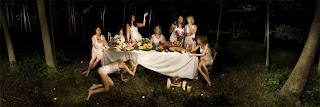
Rising Star - Stephanie Brunia, a graduate student at the University of New Mexico, became DMAC curator Gilbert Vicario’s latest discovery. That museum showed a series of her prints that mimicked classics like Leonardo‘s “The Last Supper,” Michelangelo’s “Pieta,” and John Everette Millais’ “Ophelia” with decidedly modern, edgy takes of young girls in white underwear.
Tuesday, December 13, 2011
Sarah Grant
 Des Moines’ Art Mama
Sarah Grant is the mother of Des Moines‘ ar scene. More than any person, agency or organization, she gave birth to it, bestowed an identity on it and nurtured its growth. When Grant started Sticks in 1985, as a one person studio, committed artists in Des Moines had to choose whether they wanted to be artists, or to live here. Her company let them do both, by giving full time jobs to some 100 artists at a time. They formed the creative core that snowballed into a legitimate art scene. Sticks makes furniture and art that is now sold in fine galleries and art museums all over the country. Its design work has become as recognizable as an icon, making it easy for tourists from Des Moines to spot it in Los Angeles or New York and feel some local pride.
Grant’s personal art career is also best known in large scale. She constructed, with Michigan architect Stephen Fry, a 30,000 pound kitchen table atop downtown Grand Rapids’ Blue Bridge.
Her giant murals “What I Love About Iowa State,” “We Shall Know Iowa State University by Its Myriad Parts,” and “My World Is So Full of Many Things,” grace Iowa State’s campus. She won an Honor Award from the American Institute of Architects.
Grant has also chronicled her emotional life in abstract paintings. Her annual shows at Olson-Larsen Galleries have been distinguished by moody colors that have made her fans either happy or sad for her. Whether dark or sunny, Grant’s paintings have always been characterized by heavy layering. Even in gay years, they revealed a compulsiveness that almost seemed penitent. One fan called it “the yin to the carefree yang of Sticks.”
Her current exhibition of new work is remarkably restrained. I’m tempted to say it’s better edited. However, painters don’t have an editor’s luxury of going back and subtracting the superfluous. So it’s more as if Grant has attained a new clarity and now simply intuits when less is more. This year’s work is also more narrative and less abstract. She even pushes narratives with playful Sticks-like titles such as “With Bloodhounds, Band-aids Don’t Work,” “Is It Good News?,” “Four Guys in Sports Coats & Ties.”
Most of the new pieces focus through frames within frames, as if the artist is looking reflectively through windows of perspective. “Just an Old Printmaker,” a painting added to the show at the last minute, is autobiographical. (Grant holds an MFA in intaglio printmaking from the University of Iowa.) It is also the most restrained work in the show. All Grant’s work begins as black on white. This painting adds little additional color and yet makes a most dramatic impact.
This exhibition plays through Nov. 26 along with shows of new works by printmaker Paula Schuette Kraemer and painter Thomas Jewell-Vitale. Kraemer exhibits visual prayers, for nurseries and kennels, that have long distinguished her career. Jewell-Vitale reveals a dramatically different palette within his familiar medium of oil and wax. He deserts his trademark cool colors for a sunny excursion to new emotional territory.
This exhibition plays through Nov. 26 along with shows of new works by printmaker Paula Schuette Kraemer and painter Thomas Jewell-Vitale. Kraemer exhibits visual prayers, for nurseries and kennels, that have long distinguished her career. Jewell-Vitale reveals a dramatically different palette within his familiar medium of oil and wax. He deserts his trademark cool colors for a sunny excursion to new emotional territory.
Touts
Paintpushers, a group of past and present Sticks artists, are holding their tenth anniversary retrospective at Heritage Gallery through December 1… Jeremiah Elbel, a Des Moines artist who won England’s Saatchi Prize, is exhibiting in Iowa State University’s Memorial Union Pioneer Room through Dec. 5. An artist reception will be held Nov. 30, 5 p.m. - 8 p.m.… Robyn O’Neil, who rocked the Des Moines Art Center two years ago with her black & white visions of Armageddon, is currently exhibiting a single drawing, “Hell,” which took two years to complete and includes 65,000 characters, at New York City’s Susan Inglett Gallery… Des Moines painter Alex Brown has begun work on next year’s return exhibition at Feature Inc., a renowned New York City gallery. He will show drawings as well as paintings this time and a new, retro style.
Thursday, November 17, 2011
In the Details, or Not
"My religion consists of a humble admiration of the illimitable superior spirit who reveals himself in the slight details we are able to perceive." Albert Einstein
Houston scientist-artist-disc jockey Dario Robleto hangs out near “the boundaries of life - those strange places where the longest of odds are defied.” There he seeks the world’s oldest living humans, curators for The Guinness Book of World Records, survivors of lightening strikes, and scholars of antiquated medical practices, defiant gardens (built by soldiers in combat zones) and trench art (found object art built during combat). Robleto spends much of each year with scientists who study glaciers, collecting the flotsam of their melting masses - things like cave bear claws and wooly mammoth tusks. He also kicks around with North Sea fishermen, wounded soldiers and admirers of anything bizarre.
“I want to find the unexpected strangeness of a moment,” he explained.
A casual walk through the Des Moines Art Center’s exhibition “Dario Robleto: Survival Does Not Like in the Heavens” might reveal nothing more spectacular than “another Day of the Dead memorial” as one opening night visitor described it. Like Einstein though, Robleto finds his inspiration in slight details. Just consider the media with which he works. In “No One Has Monopoly Over Sorrow,” he built of basket out of the skeletons of human soldiers’ ring fingers, covered with lead from melted bullets. The rest of that piece consisted of shrapnel, waxed dipped bridal bouquets, flowers of human hair that was braided by a a Civil War widow, and fragments of a mourning dress.
A casual walk through the Des Moines Art Center’s exhibition “Dario Robleto: Survival Does Not Like in the Heavens” might reveal nothing more spectacular than “another Day of the Dead memorial” as one opening night visitor described it. Like Einstein though, Robleto finds his inspiration in slight details. Just consider the media with which he works. In “No One Has Monopoly Over Sorrow,” he built of basket out of the skeletons of human soldiers’ ring fingers, covered with lead from melted bullets. The rest of that piece consisted of shrapnel, waxed dipped bridal bouquets, flowers of human hair that was braided by a a Civil War widow, and fragments of a mourning dress.
In “Defiant Gardens” Robleto used paper he made from letters exchanged between soldiers and their wives or sweethearts, the skeletons of carrier pigeons, carrier pigeon message capsules, dried flowers collected on famous battlefields, mourning dress fabric, bullets and shrapnel, seeds, seashells, silk, gold leaf and glass. Even the small letters folded into carrier pigeons’ message capsules were from actual battlefield correspondences. This work could be mistaken for a funeral wreath, but only before the slight details are perceived. “Some Longings Survive Death” uses 50,000 year old wooly mammoth tusks, hair flowers that intertwined hair of various 19th century lovers with that of mammoths, plus ivory, bone, ribbon and typeset. That work was enshrined in a case made of bocote, an endangered wood.
“The Common Denominator of Existence Is Loss” is the most dramatic piece in the show. A spotlight shines through a showcase, also made of bocote, which holds the paws of cave bear skeletons which have been extinct for 50,000. They are intertwined with human hand skeletons around a braid of audiotape which holds the first human recording in history. Shadows move under the showcase.
Other pieces in the exhibition are considerably more whimsical, mostly sweet parodies of music album covers and historical signs. Everything though is far more than the sum of its extraordinary parts. This exhibition plays through Jan. 15.
 At Moberg Gallery, Mary Kline-Misol unveiled her two year series “Awakenings: The Journey from Pain to Empowerment.” Painting portraits of Des Moines’ homeless became therapeutic for Kline-Misol whose husband, artist and surgeon Sinesio Misol, killed himself in 2010. The portraits in this exhibition leave faces poignantly unfinished, missing the fine details in Kline-Misol’s other portrait series (including a pair of Mahatma Gandhi and George Washington Carver that were unveiled last week at World Food Prize headquarters), or even in marvelous head studies of the same subjects included in the Moberg show. Sometimes the devil is in the detail, sometimes in their detachment.
Touts
After a year off, Metro Arts Expo will feature fine art by juried artists from across the United States, Nov. 4 and 5 at Capitol Square… Paintpusher’ s Ten Year Exhibition features 31 current and alumni artists of the influential Des Moines art collective. Through Dec. 1, with a reception Nov. 12… Olson-Larsen Galleries hosts new works by Sarah Grant, Thomas Jewell-Vitale and Paula Shuette-Kraemer, through Nov. 26.
Thursday, October 13, 2011
A Sobering September
 September is a virtual second Lent for Des Moines’ art scene, a sobering season that follows a Mardi Gras summer filled with big festivals and light entertainments. At the Des Moines Art Center “Survival Does Not Lie In The Heavens” takes the Lenten theme to existential lengths. That major show of Texas conceptual artist Dario Robleto opens September 23 to explore longevity and extinction.
Metro Arts Alliance and Des Moines Social Club take the post Mardi Gras theme more literally with “Sweeping Up the Mess” opening this Friday at White Carpet Gallery at Hillyard (4267 109th St., Urbandale). That juried exhibition of painting, sculpture, poetry, and other art forms requires the use of custodial supplies and highlights Iowa’s refugee community. Rex Haussmann, Deb Seeger, Jennifer Rivera, Jason Barr, Katherine O'hara, and Yarn Dawgz will exhibit.
At Moberg Gallery, Thomas Jackson’s “Child’s Play” continues a forty days run providing an ironic look at the ambiguity of American character. For a decade now, Jackson has been composing stacked images that consider a subject from seemingly incongruous points of view. His choice of subjects has been influenced by Robert Frank’s mid - 1950’s series “The Americans.” That work, which reduced 28,000 images into a seminal look at the national character in mid century. Jackson has been trying to do the same thing for the new millennium. While most of his imagery began as a photographic safari, he now translates much of it into paintings and ink brush drawings. His most dramatic painting, “Photo Op,” stands on its own and translates a famous film image of George W. Bush hearing the news of the 9-11 disaster into giant pixels.
The dominant ambiguity of Jackson’s new show stacks images of child’s play with deadly serious stuff like hand guns, violence, sex and advertising. “American Cypher 40” places a doll house under the image of an actual row house that barely looks real. In another, a messed up hotel bed is stacked over another doll house. Clenched teeth of an anxious lady stand above symbolic ruby slippers. Several works use hand guns and rifles juxtaposed with the toys of little boys. Toy trucks collide in one ominous childhood scene while another toy truck graces a dashboard in an eerie dessert. Wedding cake figures of a bride and groom lurk over dancing senior citizens in another. One collage of photographic images compiles roadside attractions that fight for tourists’ attention. This show plays through October 1.
Other area artists have been busy with large public commissions. Frank Hansen’s three story mural on the side of a Des Moines Street building has been turning heads for much of the summer. People love it and people hate it with equal fervor. Des Moines artists Thomas Rosborough and William Barnes won commissions by the Army National Guard and the United States Army Reserve to paint a giant mural in the new Armed Forces Reserve Center in Middletown, Iowa, as part of Iowa’s Art in State Buildings program. Also in that program, Sarah Grant is currently in residence at Iowa State University creating an installation within the atrium of Horticulture Hall, as part of the Horticulture Teaching and Research Greenhouse Complex.
Locally works by William Barnes, Scott Charles Ross and John Preston will be shown at Olson-Larsen Gallery through October 8. New, more whimsical works by Jamie Navarro are on display at Pegasus Gallery, along with large paintings by the late Don Dunagan. Hilde DeBruyne-Verhofste and John Schwatzkopf are showing through at the Polk County Heritage Gallery. An opening reception will be held this Sunday.
Two Iowa artists are showing in America’s first and second cities. Anthony Pontius opened last week in “Shirts & Destroy,” a major group show at Tara Mcphearson’s “The Cotton Candy Machine” Gallery in New York City. Brent Houzenga’s show “Remixed Media” continues at Pawn Works in Chicago.
August Is the New October for Color
 Three new exhibitions in Des Moines examine color from different points of view. Less (color) is more in Steven Vail Fine Arts current exhibition “Selective Color in Printmaking.” Curator Breianna Cochrane talked about the show’s forefather.
“Barnett Newman, a color field painter, came under fire when the National Gallery of Canada bought one of his works for $1.8 million in 1989. A nearly monochromatic piece of blue and red, it was mocked for its simplicity and extravagant cost, to the point where it was slashed with a knife by an angry viewer. Without innovations like that, the path to selective color might never have been explored.”
The Vail show, which h. In this show their works explore how minimal uses of color - black, as drawn attention from the New York City art media, includes works of such pathfinders from five different countries, some with big names: Rita Ackermann, Kamrooz Aram, Carlos Amorales, Donald Baechler, José Bedia, Ross Bleckner, Robert Cottingham, Eric Fischl, Wayne Gonzales, Antony Gormley, Beverly Semmes, Josh Smith, Pat Steir, and Donald Sultan. They demonstrate how restrained use of just black, white, gray and the primary colors can have major dramatic impact in reductive art. Using a variety of print media, their works communicate more through texture, pattern and balance, avoiding the use of color as their primary expressive tool.
“The simplicity inherent in primary colors is often reflected in the pieces themselves,” Cochrane explained.

Matt Corones designed this shirt to match his window installations.
Less (volume) is also more as the Des Moines Art Center’s “Iowa Artists 2011” continues with just two works by Matt Corones- large-scale “stained glass” windows in the museum’s lobby and Pei wing. These were each built with three patterns, based on photographs of flowers, and digitally-created patterns influenced by Middle Eastern decoration and by "Matisse Camouflage," - brightly-colored riffs on the Modernist master’s cut-paper collages. Each pattern was printed on large sheets of transparency film, which were then layered on top of one other and adhered to the glass. The effect is anything but minimal color wise - it dazzles entire rooms. These windows will be on exhibit through October 2.
In a separate exhibit under the “Iowa Artists 2011“ umbrella, Matthew Kluber presents a series of abstract “paintings” that also reference Barnett Newman. They profess an additional debt to the color studies of Joseph Albers, in which one color changes by its association or proximity with another. Kluber fuses color, line, digital formations, and projected light to create dramatic visual spaces with more of an embrace of new technologies than the works at Vail. His exhibition continues through October 2. Corones and Kluber will both speak at the museum on September 1.
Road trips to two Iowa art museums offer far more traditional experiences. Mason City’s MacNider Art Museum is exhibiting forty original photogravure prints by Edward S. Curtis, through October 29. That selection provides an overview of Curtis’s legendary “The North American Indian Collection.” Famous images like “Geronimo” and “Cañon de Chelly – Navaho” mix it up with lesser known but equally intriguing images like “Bear Bull – Blackfoot” and “Wichita Grass-House.” Cedar Rapids Museum of Art is preparing for a September 3 opening of its exclusive showing of “An American Masterpiece: Charles Wilson Peale's George Washington.” Commissioned by John Hancock , this was Peale’s first portrait of Washington to portray him as commander in chief of the Continental Army. America’s daddy will hang around until New Year’s Eve.
Notes
Ames artist Peter Goché’s “Water Hutch,” has been on exhibit this summer in Omaha’s Bemis Center for Contemporary Art… Moberg Framing plans a September opening of the their new shop on Ingersoll… Frank Hansen will auction several of his paintings at The Mansion September 24 in a “Paint It Black” event. Any painting that does not receive a minimum bid will be painted black and recycled. The Snacks will play.
Subscribe to:
Posts (Atom)

