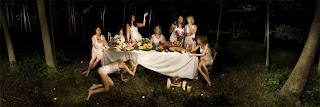
 A Year of Unexpected Strangeness
“The unexpected strangeness of the moment.” Artist Dario Robleto used those words to explain the qualities he sought in his art, exhibited in the Des Moines Art Center’s (DMAC) “Survival Does Not Lie In The Heavens.” His phrase works just as well though as an explanation of the year 2011 in Des Moines’ art scene. It was a year in which unexpected media such as dirt, projected light and neon often stood in for paints, when green eggs and lasers became sculpture, when worldly artists like Bill Luchsinger unexpectedly turned their visions upon local subjects, and when Stephanie Brunia’s girls in white underwear, Tom Jackson’s children with guns and Jeremiah Elebl’s decapitated humans became subjects of exceptional exhibitions.
The year ended with an unexpectedly strange controversy. Half a century after Andy Warhol placed low culture’s signage (Campbell‘s) on the walls of high culture’s grandest palaces, local paragons of elite culture raised a public fuss about Subway’s signage on Subway’s own venues, at least when they were visible from the perspectives of high culture. Still excellence stood out amidst the strangeness:
Artist of the Year - Sarah Grant’s exhibition at Olson-Larsen demonstrated a new clarity, as if the artist simply intuited when less had become more. Her new work was also more narrative and less abstract than in past years. A ten year retrospective of Paintpushers, almost all artists who were recruited here and employed by Grant, further demonstrated her extraordinary influence on the city’s entire art scene.
People of the Year - TJ and Jackie Moberg nearly doubled the number of artists in their Moberg Gallery stable, salvaged the defunct Art Store’s inventory, saved all the jobs of that company’s employees, opened Moberg Framing, Moberg Editions (an online gallery selling inexpensive art) and Moberg Consultations (a full service firm that directs clients from design to installation of artworks). TJ also worked on a major installation at Prairie Meadows.
Painter of the Year - Matthew Kluber’s series of abstract “paintings” in his DMAC exhibition fused color, line, digital formations, and projected light to create dramatic visual spaces that embraced new technologies.
Exhibition of the Year (museum) - German Anselm Reyle’s exhibition at DMAC introduced Iowans to the contemporary German scene, where in the artist’s words “Cologne is the past. Berlin is the future.” Chrome, bronze, piano lacquer, plinth, aluminum, glass, neon, electric cables, rust, plastic, LED lights, and wood veneer hung out with more traditional Modernist media.
Exhibition of the Year (gallery) - Travis Rice’s “Contamination” became the largest one person show ever at Moberg, taking up the entire gallery plus an outdoor wall. It was inspired by a sci fi film was about alcoholism, green eggs and coffee, in which the green eggs plotted to take over the world.
Exhibition of the Year (non-traditional venue) - “Jeremiah Elbel” at Mars Coffeehouse exhibited a monstrously talented young artist’s black and white, tar and charcoal portraits of decapitated humans - some Mexican drug war victims, some victims of Islamic terrorists, others of Shari'a, or French law.
Design of the Year - InVision’s two story, glass and steel addition to the Iowa State Veterinary Teaching Hospital glowed like a sanctuary on a storm-plagued prairie. It finally presented a coming home platform for Christian Peterson’s iconic statue “The Good Doctor.”
New Artist of the Year - Madai Taylor painted with earth, red dirt of the South and black loam of Iowa, mixed with gesso. That paint was applied in layers on which he scratched while they were drying, much like the plows of agriculture scratch at the same dirt in its natural environment. He process becomes a unique form of shorthand - a primitive scripture.
Rising Star - Stephanie Brunia, a graduate student at the University of New Mexico, became DMAC curator Gilbert Vicario’s latest discovery. That museum showed a series of her prints that mimicked classics like Leonardo‘s “The Last Supper,” Michelangelo’s “Pieta,” and John Everette Millais’ “Ophelia” with decidedly modern, edgy takes of young girls in white underwear.


