
Bustling every weekend with camera-laden visitors, the the garden park has become extraordinarily popular with locals and tourists alike. A bright happenstance during an economic recession, the New York Times even proclaimed the PSG a “cure from urban blight.” As its novelty ages and the value of free entertainment depreciates in a hopefully revived economy, now’s a good time to ponder what might be the city’s next move.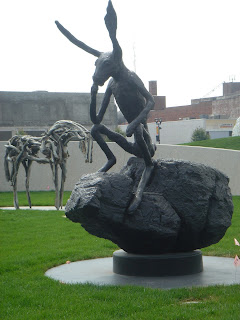 I posed the following question to some keen observers of Des Moines culture:
 “What can be done to capitalize of the Pappajohn’s largess to help Des Moines become known as “a sculpture town” rather than just a town with a downtown sculpture park?
Des Moines Art Center Director Jeff Fleming likes what’s already been done.
“I think that we’re already moving in this direction. The Principal River Walk project has two major sculpture works in progress. The Parks Department has completed one project by creating a sculpture map to downtown and they have another in the works that identifies, with consistent standards of identification, sculptures of note all over the entire metro area. I think the most important thing is to progress with a focus on maintaining an enhancement of quality,” he said.
Journalist Chuck Offenburger also thinks the Parks Department map will lead to more good things.
“First, I’d say a detailed study should be done to identify and locate the most interesting existing sculptures around metro Des Moines. Of course there’s “Crusoe Umbrella.” But we forget some of the intriguing ones – like the tricycle rider in Merle Hay Mall, the tree carvings at the Iowa State Fairgrounds, some of the statues in the Iowa Hall of Pride, the string quartet at Drake, the stylized baseball outside Principal Park, the new Paragon Prairie Tower in the extreme northwest corner of the metro, those at the Art Center, the various military-related statues, some of the best church ones, those on the State Capitol grounds, some great ones in businesses (Mac Hornecker’s in the Iowa Farm Bureau headquarters lobby), and some good ones that might be accessible to the public at private residences.
“That could 1) make it possible to put together a new self-guided “Sculpture Tour” of the city, with occasional escorted tours. 2) It could also identify areas of the city that are really short of sculptures and may stir ideas of what new pieces could go there and 3) If we’re really paying attention to sculpture in Des Moines, that might lead to some new funding sources to commission new pieces – and one of the first ones we should get done is a big one by Sticks, since their headquarters is in Des Moines,” he said.
Sculptor James Ellwanger, who created several of the pieces Offenburger mentioned, agrees that new commissions could stimulate a positive image for the city. He’d like to see it result from a sculpture prize though. Noting that Chicago’s image as America’s greatest architectural city was boosted by the Pritzker Prize, he mused about a competition at the Iowa State Fair.
“They have a million visitors and lots of open space. They already have arts competitions and they’re moving those into a new venue. It would be a great place for sculptors to bring works,” he said.
Author John Domini likes the prize idea and adds that legislation requiring sculpture in new developments has worked imaging miracles in Portland, Oregon and New York City.
“The Portland legislation is called "1% for Art," and it's meant that even the city-center shopping malls Lloyd Center & Pioneer Place have eye-catching, mind-bending sculpture installations at all four entrances. Even parking garages have them, lightening the tomb effect. As for New York, Manhattan has recently grown full of sculpture in public, on block after block, park after park,” he noted.


 This 35-year-old sculptor burst upon the art world like Barack Obama taking the White House. Clark’s “Simulation of the Triumphal Entry of the Christ,” performed on the eve of the Presidential inauguration, was a prelude to his stunning sense of artistic relevance and the unrealistic expectations of these times.


