Monday, January 21, 2013
Life is an open painting
Outside of literature, autobiographical art is a hard sell. Louise Bourgeois managed to insert her life story in sculpture by using recognizable symbols (like spiders) of her inner demons thus making the art more universal and less opaque. It’s even tougher to tell your life story in flat media like painting and printmaking. Still two local artists defy the odds.
Lee Ann Conlan used to paint large $12,000 canvasses, with big, Boschian themes like evil and punishment. She did quite well, selling out shows in the first half of the last decade. Her latest exhibition at Thee Eye reveals a swing in her choices of media and subject matter.
“I went back to school to study graphic arts. The new technologies are so amazing. You can work in so many layers of images and words. I’ve always want to do a visual book so I made this series (of digital collage prints),” she explained of a slick $40, 70 page book of prints that mostly sell for $30 to $60 each.
“It’s another time now economically. People don’t need art like they need food and shelter. It’s one of the first things they cut out their budget. I want my art to be in more homes, so I became more accessible,” she said.
The dominant series (Souvenirs) in her new show is painfully autobiographical, like a diary of a lifetime of absorbed cruelties. “Actually, it was all just one guy, (depicted here as “Little Man“ and “Dirte“). Fear becomes anger and anger has to end with humor if you want to get through it all,” she explained.
Her titles explained a lot. “Nobody likes you. They only pretend to like you because you hang out with me.” “You’re fucking me and kissing my tears.” “I’d like to grab you by the hair and sell you to the devil.” “I was in shock that you could hate me in a matter of days. I already hated you.” One piece told how that abusive relationship ended, depicting an SUV, via Google Earth, in the parking lot of the Lumberyard (strip club) with an inserted photo of two infants left alone. Another (“The Randolph”) placed a woman on the floor of a crack house. “It was the day after St. Patrick’s Day and I woke up to discover that I was in Mexico and that I was married,” she recalled.
Another series in the show told about another bad relationship. For it she sewed 80 feet of “love letters,” scribbled on all kinds of paper, to her medical records (from a fractured skull). She called this “Red Flags,” to chastise herself for not sensing the danger implied in the strange letters. This show runs through June.
At Moberg Gallery Frank Hansen recently explained his penchant for autobiographical art. “I believe my life is more interesting than most. I am Frank. I am the definition of my name. If you don‘t like it, too bad.”
His current show “Growing Up Hansen” (through July 7) tells stories about his “bad-assed drunk” father: extracting teeth in the family kitchen; using an ax on the clothes dryer; dragging the family to yard sales “until we were surrounded by junk;” and taking gunshots at airplanes flying too close to the ground. There’s also a “hay ride wrapped in infamy,” “pre-sexual sex dreams,” the accidental (or not) burning of his grandma’s farm, and a pet duck frozen in the snow.
Side Galleries
Robert Spellman’s recent one night exhibition was held in a parking garage under an East Village pub. His dazzlingly colored impressionist paintings rocked the dark bowels of that venue… Pete Goche’s “Water Hutch” is on exhibit through August 5 at the Soap Factory in Minneapolis. It was one of just 7 pieces selected from more than 500 international applications to the experimental gallery.


Des Moines Arts a 25 year review
Twenty five years ago I became an arts writer, accidentally. I published a whimsical editorial (“I’ve seen the future of the arts - it looks like baseball”) in The Washington International Arts Letter (WIAL). That publication was the main guide for information about funding in the arts before the internet rendered it obsolete. My piece proposed that symphonies, operas, art museums, ballets and such would all benefit by adopting the structure of baseball’s farm system. Des Moines’ arts organization could become AAA affiliates of Chicago‘s, tutoring young prospects while increasing the marketing clout of both.
Arts non profits were becoming desperate back then. Attendance was down and so was earned income as a percentage of operating budgets. Their devoted fans and donors were aging and younger generations cared more about sports, rock bands and Broadway shows. In that climate, my idea was taken seriously. I was invited to speak at arts seminars and to become editor of the WIAL. My fifteen minutes lasted less than a year. The farm system analogy sounded good in theory but died hopelessly in the real world, where unions and insurers squashed it. I continued writing about the arts for a quarter century. These were the biggest agents of change that I noticed:
Big corporate donors reorganized the way money was distributed to non profits by putting marketing departments in charge of those decisions. They demanded quid pro quo, so non profits had to convince donors that they were getting some positive return. This led to silly things like naming rights for drinking fountains and toilets, but also to far more educational services. Those programs and events recruited a future fan base and earned income rose.
Robert Maplethorpe and Andres Serrano offended social conservatives with erotic and profane art that had indirectly received grant money from the National Endowment for the Arts (NEA). This led to the creation of new levels of bureaucracy, both public and private, to build walls between big donors and ultimate consequences of their largess. The Iowa Department of Cultural Affairs was our state version, BRAVO and Greater Des Moines Music Coalition (DMMC) regional ones, Metro Arts Alliance a civic one.
Sociologist Richard Florida published “Rise of the Creative Class” in 2002. He theorized that successful cities of the future must pander to a new class of workers who hate suburban sprawl and love bike trails, sports arenas, skate board ramps, historic old buildings, cheap rent, trendy cafés & boutiques, multiculturalism, and, above all, a lively contemporary music scene. Florida’s theories were discredited soon after they were published - his ten “most creative cities” barely created more jobs than his “ten least creative cities.” It didn’t matter, every town was afraid they‘d be left behind if they didn‘t build to Florida‘s models. Iowa hired him in 2005 to brand its Great Places program. Every seminar or focus group I attended the last decade was filled with drinkers of Florida Kool-Aid. Most artists and arts organization seeking grant money claimed to be an essential part of the Florida vision. Des Moines’ creative class - of administrators - grew again.
More interesting work was done by impresarios doing business the old fashioned way - making money by developing talent. A lively music scene arose here because club and bar owners took risks that live music, from near and far, would pay off. New gallery owners and art makers (Sticks) gave young artists a place to test the market for their talent. Some developed farm system-like alliances with galleries in Chicago, Kansas City and Los Angeles.
The role these people played has been underestimated, at least by the administrative class. Last month, a DMMO awards ceremony honored a marketing administrator, a board member, a band leader, a radio personality and a guitar maker but presented nothing to any promoter, club or bar owner. Those people made it possible for musicians to make a living here, rather than leaving town. I doubt any of them ever read Richard Florida.
Sunday, August 12, 2012
Reliquaries, Paraphilia & Coincidence
Des Moines Art Center’s “Tony Feher” retrospective stretches the museum in more ways than one. “Tony’s done 160 exhibitions since the early 1990’s, mostly in site-specific venues. I don’t think anyone has ever attempted a retrospective of that sort of thing. And of all the places this show is traveling, Des Moines is special because we were able to invade the permanent collections. So look for the show in the Pei and Meire wings as well as in its own gallery,” explained curator Claudia Schmuckli, from Houston’s Blaffer Gallery.
Feher likes his art defies some expectations. “I was a struggling painter until one day I saw some marbles in the window of a toy store, with the light hitting them in just the right way. I bought them and put them in jars,” he explained of his style’s origin. One thing led to another. Because AIDS was taking so many lives unexpectedly, he began putting things in jars that served as memorials. Soon his jars were being exhibited and described as modern reliquaries of collective memory. Jars led to plastic bottles which he hung in trees, high enough so that his art could not slam dunked by locals. “I was drawing with rows of bottles,” he explained. He’s now “drawn” on some famous museums, discovered all kinds of unorthodox art materials, and installed living art (apple trees) in the courtyard of the city of Rockford, Illinois. Tony Feher plays through September 2.
Des Moines poet Mia L. Farrell published “Perverse Moments,” an adult coloring book that graphically and hilariously defines forty or so fetishes and paraphilia, a.k.a. sexual perversions. Her inspiration was the Garbage Pail Kids of the 1980’s.
“I loved their irreverent combination of two of my favorite qualities: huggable, wholesome cuteness and blatant, uncensored hard core, vomit inducing grossness. It made for such a beautiful thing,” she explained. Farrell thought it was time to inject sex into a similar Hegelian dialectic.
“So with the extreme wealth of sexual knowledge available on the internet, I set out to draw page after page of the cutest, kinkiest cartoons.” She succeeded. Her first printing sold out quickly and at least one big time distributor is interested. She says it’s about education.
“If something makes us too uncomfortable to find humor in it then we’re choosing to remain too afraid to ever understand it.”
Former University of Iowa art school icons Mauricio Lasansky and Elizabeth Catlett died in April, just days apart from each other, and each just weeks one side or the other from their 97th birthdays.
Touts “Exposition Henry Moore,” currently at Steven Vail Fine Arts, includes lithographs, etchings and mixed media works relating to the artist’s iconic “Mother and Child” and “Reclining Figures” series. A collaboration with Osborne Samuel of London, it’s the first exhibition of its kind in the United States. The works span 1963-1983, demonstrating a range of Moore’s working styles. The exhibition plays through July 20. … Frank Hansen’s first local exhibition in two years debuts May 18 at Moberg Gallery. Hansen’s often autobiographical explorations of Iowa’s past and present always bring out one of the year’s wilder gallery gatherings… Chris Vance has been Des Moines’ most collected painter for awhile but his latest show at Moberg set new sales records. Paintings sold so briskly that the entire show had to be re-hung with new works before it was over… “All Fired Up - Works in Clay” at Polk County Heritage Gallery presents a veritable student all star show from RDG Dahlquist Art Studio, through June 7.
Feher likes his art defies some expectations. “I was a struggling painter until one day I saw some marbles in the window of a toy store, with the light hitting them in just the right way. I bought them and put them in jars,” he explained of his style’s origin. One thing led to another. Because AIDS was taking so many lives unexpectedly, he began putting things in jars that served as memorials. Soon his jars were being exhibited and described as modern reliquaries of collective memory. Jars led to plastic bottles which he hung in trees, high enough so that his art could not slam dunked by locals. “I was drawing with rows of bottles,” he explained. He’s now “drawn” on some famous museums, discovered all kinds of unorthodox art materials, and installed living art (apple trees) in the courtyard of the city of Rockford, Illinois. Tony Feher plays through September 2.
Des Moines poet Mia L. Farrell published “Perverse Moments,” an adult coloring book that graphically and hilariously defines forty or so fetishes and paraphilia, a.k.a. sexual perversions. Her inspiration was the Garbage Pail Kids of the 1980’s.
“I loved their irreverent combination of two of my favorite qualities: huggable, wholesome cuteness and blatant, uncensored hard core, vomit inducing grossness. It made for such a beautiful thing,” she explained. Farrell thought it was time to inject sex into a similar Hegelian dialectic.
“So with the extreme wealth of sexual knowledge available on the internet, I set out to draw page after page of the cutest, kinkiest cartoons.” She succeeded. Her first printing sold out quickly and at least one big time distributor is interested. She says it’s about education.
“If something makes us too uncomfortable to find humor in it then we’re choosing to remain too afraid to ever understand it.”
Former University of Iowa art school icons Mauricio Lasansky and Elizabeth Catlett died in April, just days apart from each other, and each just weeks one side or the other from their 97th birthdays.
Touts “Exposition Henry Moore,” currently at Steven Vail Fine Arts, includes lithographs, etchings and mixed media works relating to the artist’s iconic “Mother and Child” and “Reclining Figures” series. A collaboration with Osborne Samuel of London, it’s the first exhibition of its kind in the United States. The works span 1963-1983, demonstrating a range of Moore’s working styles. The exhibition plays through July 20. … Frank Hansen’s first local exhibition in two years debuts May 18 at Moberg Gallery. Hansen’s often autobiographical explorations of Iowa’s past and present always bring out one of the year’s wilder gallery gatherings… Chris Vance has been Des Moines’ most collected painter for awhile but his latest show at Moberg set new sales records. Paintings sold so briskly that the entire show had to be re-hung with new works before it was over… “All Fired Up - Works in Clay” at Polk County Heritage Gallery presents a veritable student all star show from RDG Dahlquist Art Studio, through June 7.
Thursday, June 14, 2012
Life Imitating Art Imitating Life
Sixty years ago art critic Harold Rosenberg wrote that Jackson Pollock had “transformed painting into an existential drama” in which "what was to go on the canvas was not a picture but an event.” Pollock’s seminal painting “Mural” arrived in Des Moines earlier this month as both big event and existential drama in this, the 100th anniversary of Pollock’s birth.
To celebrate Iowa’s prime spot in the art world, Des Moines Art Center (DMAC) invited members to a pre-launch party for the unveiling of “Mural,” which is on sabbatical from the University of Iowa floodplain. Over 500 people returned RSVP’s. Many more showed up as super star art patrons John and Mary Pappajohn hosted the bona fide gala. Three cops patrolled the parking lots. Cars were parked all the way to the old Science Center. Shrimp were super sized and booze was top shelf.
Pollock was an All American cultural meteor on a crash course with destiny in real life and myth. He was born in Cody, Wyoming, a town named after Buffalo Bill whose life and mythology resembled Pollock’s in many ways. Expelled from two high schools, Pollock tagged along on surveying missions with his father to Native American reservations. A long time alcoholic, he coped with his addiction through Jungian therapy but died at age 44. Before his final fatal fling with drunken driving, Pollock also stole Abstract Expressionism from the Germans, remodeled it in epic proportions, Americanized it by synthesizing Navajo sand paintings with Jungian motifs, and shifted the axis of the art world from Paris to New York City. Those are just the non controversial highlights of his legacy.
“Mural” is usually considered the work that jump started all that transformational art stuff. DMAC Director Jeff Fleming explained. “It changed the way Americans painted pictures and in turn changed the way that western visual culture operated after World War II. A part of that was in its scale. In contradiction to easel sized painting, it was on a grand scale, full of energy, vitality and emotion. It changed what painting could be, particularly what American painting could be. And this is the painting that started all that,” he said. University of Iowa President Sally Mason focused on encouraging DMAC patrons to oppose any legislative moves to sell the painting to raise money for scholarships, or new buildings.
“Mural” is estimated to be worth around $150 million. The proposal to sell it (publicly articulated by Michael Gartner who is both a former President of the Iowa Board of Regents and an owner of this newspaper’s parent company) has garnered enough support to worry many folks who attended the Pollock party.
Everyone speaking at the gala seemed rather passionate about keeping “Mural” in Iowa, for several reasons: The painting was given to the university in large part to recognize the incredible talent that made its art school famous, including Grant Wood and Philip Guston; The University pioneered the concept of making painters into teachers; Pollock’s parents grew up in Iowa; The painting is a Hawkeye heirloom.
Art Touts
A retrospective of paintings by Byron Burford plays at Olson-Larsen Galleries through May 26. Burford came to the University of Iowa to study with Grant Wood. He left only to serve in World War II, teaching several generations of grateful students. Jazz and the circus motifs show off his lyrical perspective of 20th century America… Chris Vance, Des Moines’ most collected painter, is featured at Moberg Gallery through May 11. His paintings have been selling so briskly that this entire show might be re-hung with new works before it’s over… Former University of Iowa art school icons Mauricio Lasansky and Elizabeth Catlett died in April, just days apart from each other, and each just weeks one side or the other from their 97th birthdays.
Thursday, May 10, 2012
Des Moines arts - a 25 years review
Twenty five years ago I became an arts writer, accidentally. I published a whimsical editorial (“I’ve seen the future of the arts - it looks like baseball”) in The Washington International Arts Letter (WIAL). That publication was the main guide for information about funding in the arts before the internet rendered it obsolete. My piece proposed that symphonies, operas, art museums, ballets and such would all benefit by adopting the structure of baseball’s farm system. Des Moines’ arts organization could become AAA affiliates of Chicago‘s, tutoring young prospects while increasing the marketing clout of both.
Arts non profits were becoming desperate back then. Attendance was down and so was earned income as a percentage of operating budgets. Their devoted fans and donors were aging and younger generations cared more about sports, rock bands and Broadway shows. In that climate, my idea was taken seriously. It was republished in major newspapers around the country. I was invited to speak at arts seminars and to become editor of the WIAL.
My fifteen minutes lasted less than a year. The farm system analogy sounded good in theory but died hopelessly in the real world, where unions and insurers squashed it. I continued writing about the arts for a quarter century. These were the biggest agents of change that I noticed:
Big corporate donors reorganized the way money was distributed to non profits by putting marketing departments in charge of those decisions. They demanded quid pro quo, so non profits had to convince donors that they were getting some positive return. This led to silly things like naming rights for drinking fountains and toilets, but also to far more educational services. Those programs and events recruited a future fan base and earned income rose.
Robert Maplethorpe and Andres Serrano offended social conservatives with erotic and profane art that had indirectly received grant money from the National Endowment for the Arts (NEA). This led to the creation of new levels of bureaucracy, both public and private, to build walls between big donors and ultimate consequences of their largess. The Iowa Department of Cultural Affairs was our state version, BRAVO and Greater Des Moines Music Coalition (DMMC) regional ones, Metro Arts Alliance a civic one.
Sociologist Richard Florida published “Rise of the Creative Class” in 2002. He theorized that successful cities of the future must pander to a new class of workers who hate suburban sprawl and love bike trails, sports arenas, skate board ramps, historic old buildings, cheap rent, trendy cafés & boutiques, multiculturalism, and, above all, a lively contemporary music scene. Florida’s theories were discredited soon after they were published - his ten “most creative cities” barely created more jobs than his “ten least creative cities.” It didn’t matter, every town was afraid they‘d be left behind if they didn‘t build to Florida‘s models. Iowa hired him in 2005 to brand its Great Places program. Every seminar or focus group I attended the last decade was filled with drinkers of Florida Kool-Aid. Most artists and arts organization seeking grant money claimed to be an essential part of the Florida vision. Des Moines’ creative class - of administrators - grew again.
More interesting work was done by impresarios doing business the old fashioned way - making money by developing talent. A lively music scene arose here because club and bar owners took risks that live music, from near and far, would pay off. New gallery owners and art makers (Sticks) gave young artists a place to test the market for their talent. Some developed farm system-like alliances with galleries in Chicago, Kansas City and Los Angeles.
The role these people played has been underestimated, at least by the administrative class. Last month, a DMMO awards ceremony honored a marketing administrator, a board member, a band leader, a radio personality and a guitar maker but presented nothing to any promoter, club or bar owner. Those people made it possible for musicians to make a living here, rather than leaving town. I doubt any of them ever read Richard Florida.
Monday, March 26, 2012
You can take the boy out of the mountains…
Miguel Angel Rios grew up in Argentina’s Calchaqui Valley of Catamarca. Wielding boleadores like an experienced gaucho, he became an expert hunter by the age of 10.
“We would chase wild burros and ostriches for sport. They were experts at running through sand dunes, so we would chase them until my father sensed they were tired. Then he would look at me to signal to move in and lasso them. I was also expert at the slingshot. (Partridges) would fly in straight lines so we would chase them to the river, then line up to take shots where our dogs could retrieve them,” he recalled.
Rios left the Andes to attend the Academia Nacional de Bellas Artes in Buenos Aires and to teach at the National University of Buenos Aires. Then the mountains called him home to a job at the National University of Tucuman until, at age 30, he had an epiphany.
“I realized I wanted to be an artist, not an art professor. I had to leave the Andes to do that. So I moved to New York City,” he confessed.
Artistically, Rios never left. All his work, from early collages about colonialism to his latest videos have been rooted in Andean wistfulness.
“Because of where I come from, I work with wide open spaces, not walled in spaces like Europeans. That makes sense - Catamarca is larger than Spain,” Rios explained.
Curator Gilbert Vicario titled Rios’ current Des Moines Art Center exhibition “Walkabout,” after Nicolas Roeg’s film.
“In that film, Australian school children become lost in the desert and are rescued by an aborigine boy on his walkabout. Miguel’s work provides similar guidance, to cultures that have been spiritually lost since 9-11,” Vicario explained.
 In “Rooom, Rooom” Rios returns to Catamarca to observe the slings of boleadores, some wielded by his childhood friends and their offspring.
 We observe only their shadows, dramatically elongated by filming at sunrise and sunset. The sound of the slings mesmerizes a black and white world, like the songlines of an aboriginal walkabout. Three videos provide the exhibition’s focus. They employ wide open spaces, and South American sports, to scrutinize human attraction to both spirituality and violence.
 In “Ni me busques…No me encuentras” (Don’t look for me, you won’t find me), Rios and his cinematographer take an hallucinogenic voyage on peyote through a Mexican desert. After observing a seven piece band and escaping a train, the artist enters an adode house like the one he grew up in. He hears “the sound of my mother baking bread” before the house divides itself elusively.


“We would chase wild burros and ostriches for sport. They were experts at running through sand dunes, so we would chase them until my father sensed they were tired. Then he would look at me to signal to move in and lasso them. I was also expert at the slingshot. (Partridges) would fly in straight lines so we would chase them to the river, then line up to take shots where our dogs could retrieve them,” he recalled.
Rios left the Andes to attend the Academia Nacional de Bellas Artes in Buenos Aires and to teach at the National University of Buenos Aires. Then the mountains called him home to a job at the National University of Tucuman until, at age 30, he had an epiphany.
“I realized I wanted to be an artist, not an art professor. I had to leave the Andes to do that. So I moved to New York City,” he confessed.
Artistically, Rios never left. All his work, from early collages about colonialism to his latest videos have been rooted in Andean wistfulness.
“Because of where I come from, I work with wide open spaces, not walled in spaces like Europeans. That makes sense - Catamarca is larger than Spain,” Rios explained.
Curator Gilbert Vicario titled Rios’ current Des Moines Art Center exhibition “Walkabout,” after Nicolas Roeg’s film.
“In that film, Australian school children become lost in the desert and are rescued by an aborigine boy on his walkabout. Miguel’s work provides similar guidance, to cultures that have been spiritually lost since 9-11,” Vicario explained.
In “Rooom, Rooom” Rios returns to Catamarca to observe the slings of boleadores, some wielded by his childhood friends and their offspring. We observe only their shadows, dramatically elongated by filming at sunrise and sunset. The sound of the slings mesmerizes a black and white world, like the songlines of an aboriginal walkabout. Three videos provide the exhibition’s focus. They employ wide open spaces, and South American sports, to scrutinize human attraction to both spirituality and violence.In “Ni me busques…No me encuentras” (Don’t look for me, you won’t find me), Rios and his cinematographer take an hallucinogenic voyage on peyote through a Mexican desert. After observing a seven piece band and escaping a train, the artist enters an adode house like the one he grew up in. He hears “the sound of my mother baking bread” before the house divides itself elusively. “Mecha” (Fuse) observes the game “tejos,” popular in the barrios of Bogota. To an Iowan’s eyes, it looks like bocce ball with bombs. Courts are walled off within empty factories, then youthful players toss specially constructed balls at clay tablets, some of which explode when their gunpowder fuses are hit.
We never see people, just running legs and throwing arms. Explosions are beautiful in slow motion. Continuous action becomes an allegory for war lust. Hand held cameras transmit the point of view of war journalists in combat. An accompanying cutout paper drawing appears to be an abstraction until one sees that all its shapes are gun barrels.
Rios admits a nostalgic attachment to the works in the show. “I have always felt a longing guilt for leaving,” he confessed. “Walkabout” plays at the Art Center till April 22 and moves to Museo de Art Carillo Gil in Mexico City in September.
Touts
Michael Watson’s “Familiar Faces,” at Fluxx Gallery, includes 100 portraits… Yoshitomo Nara’s “White Ghost” in Pappajohn Sculpture Park was named a “Top 20 Acquisition of 2011” in Antiques and Fine Arts… Dario Robleto’s exhibition at Des Moines Art Center was named “Top 2011 Exhibition New Yorkers Won’t See” by Guernica.
Thursday, December 22, 2011
The Art of 2011
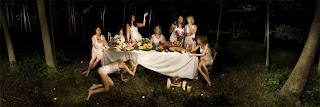 A Year of Unexpected Strangeness
“The unexpected strangeness of the moment.” Artist Dario Robleto used those words to explain the qualities he sought in his art, exhibited in the Des Moines Art Center’s (DMAC) “Survival Does Not Lie In The Heavens.” His phrase works just as well though as an explanation of the year 2011 in Des Moines’ art scene. It was a year in which unexpected media such as dirt, projected light and neon often stood in for paints, when green eggs and lasers became sculpture, when worldly artists like Bill Luchsinger unexpectedly turned their visions upon local subjects, and when Stephanie Brunia’s girls in white underwear, Tom Jackson’s children with guns and Jeremiah Elebl’s decapitated humans became subjects of exceptional exhibitions.
The year ended with an unexpectedly strange controversy. Half a century after Andy Warhol placed low culture’s signage (Campbell‘s) on the walls of high culture’s grandest palaces, local paragons of elite culture raised a public fuss about Subway’s signage on Subway’s own venues, at least when they were visible from the perspectives of high culture. Still excellence stood out amidst the strangeness:
Artist of the Year - Sarah Grant’s exhibition at Olson-Larsen demonstrated a new clarity, as if the artist simply intuited when less had become more. Her new work was also more narrative and less abstract than in past years. A ten year retrospective of Paintpushers, almost all artists who were recruited here and employed by Grant, further demonstrated her extraordinary influence on the city’s entire art scene.
People of the Year - TJ and Jackie Moberg nearly doubled the number of artists in their Moberg Gallery stable, salvaged the defunct Art Store’s inventory, saved all the jobs of that company’s employees, opened Moberg Framing, Moberg Editions (an online gallery selling inexpensive art) and Moberg Consultations (a full service firm that directs clients from design to installation of artworks). TJ also worked on a major installation at Prairie Meadows.
Painter of the Year - Matthew Kluber’s series of abstract “paintings” in his DMAC exhibition fused color, line, digital formations, and projected light to create dramatic visual spaces that embraced new technologies.
Exhibition of the Year (museum) - German Anselm Reyle’s exhibition at DMAC introduced Iowans to the contemporary German scene, where in the artist’s words “Cologne is the past. Berlin is the future.” Chrome, bronze, piano lacquer, plinth, aluminum, glass, neon, electric cables, rust, plastic, LED lights, and wood veneer hung out with more traditional Modernist media.
Exhibition of the Year (gallery) - Travis Rice’s “Contamination” became the largest one person show ever at Moberg, taking up the entire gallery plus an outdoor wall. It was inspired by a sci fi film was about alcoholism, green eggs and coffee, in which the green eggs plotted to take over the world.
Exhibition of the Year (non-traditional venue) - “Jeremiah Elbel” at Mars Coffeehouse exhibited a monstrously talented young artist’s black and white, tar and charcoal portraits of decapitated humans - some Mexican drug war victims, some victims of Islamic terrorists, others of Shari'a, or French law.
Design of the Year - InVision’s two story, glass and steel addition to the Iowa State Veterinary Teaching Hospital glowed like a sanctuary on a storm-plagued prairie. It finally presented a coming home platform for Christian Peterson’s iconic statue “The Good Doctor.”
New Artist of the Year - Madai Taylor painted with earth, red dirt of the South and black loam of Iowa, mixed with gesso. That paint was applied in layers on which he scratched while they were drying, much like the plows of agriculture scratch at the same dirt in its natural environment. He process becomes a unique form of shorthand - a primitive scripture.
Rising Star - Stephanie Brunia, a graduate student at the University of New Mexico, became DMAC curator Gilbert Vicario’s latest discovery. That museum showed a series of her prints that mimicked classics like Leonardo‘s “The Last Supper,” Michelangelo’s “Pieta,” and John Everette Millais’ “Ophelia” with decidedly modern, edgy takes of young girls in white underwear.
Subscribe to:
Posts (Atom)

